Vintage Flute Shop
Articles
“My Notes on the Accounting Records of Louis
Lot, 1855-1864”
Contents
1. Introduction
2. Catalog and
Prices
3. Serial Numbers
4. Old Pitch -
New Pitch
5. Players of
Silver Flutes 1
6. Maillechort
7. Players of
Silver Flutes 2
8. Cylindrical Wood
Flutes
9. Ring-Key Flutes
10. Other Makers
and Innovators
11. Fun Facts
12. Dayton C.
Miller’s Louis Lot Flutes
13. Piccolos
14. Ordinary
Flutes
15. French Terms
1. INTRODUCTION
A couple of decades ago, David Shorey passed along to the vintage flute community a set of accounting books from the Louis Lot workshop. These are the same records that Tula Giannini consulted while writing her book, Great Flute Makers of France: The Lot and Godfroy Families, 1650–1900. Much of her material in Chapter 8 is drawn from these fascinating records. Many of her findings 33 years ago are aligned with my recent reading of the journal.
In addition, I intend to take full advantage of this space to explore these records much more deeply and broadly, driven in part by my own curiosity as a flute maker, collector, student, and player of these historic instruments. I will pay particular attention to aspects of Louis Lot’s workshop that intersect with my own pursuits, incorporating extensive detail, journal excerpts, and comparative graphs.
This article is set in 15 sections, linked together by simple hypertext (HTML). Readers can jump around from any section to any other through the links provided in the Contents. Only external links will open in a new browser window.
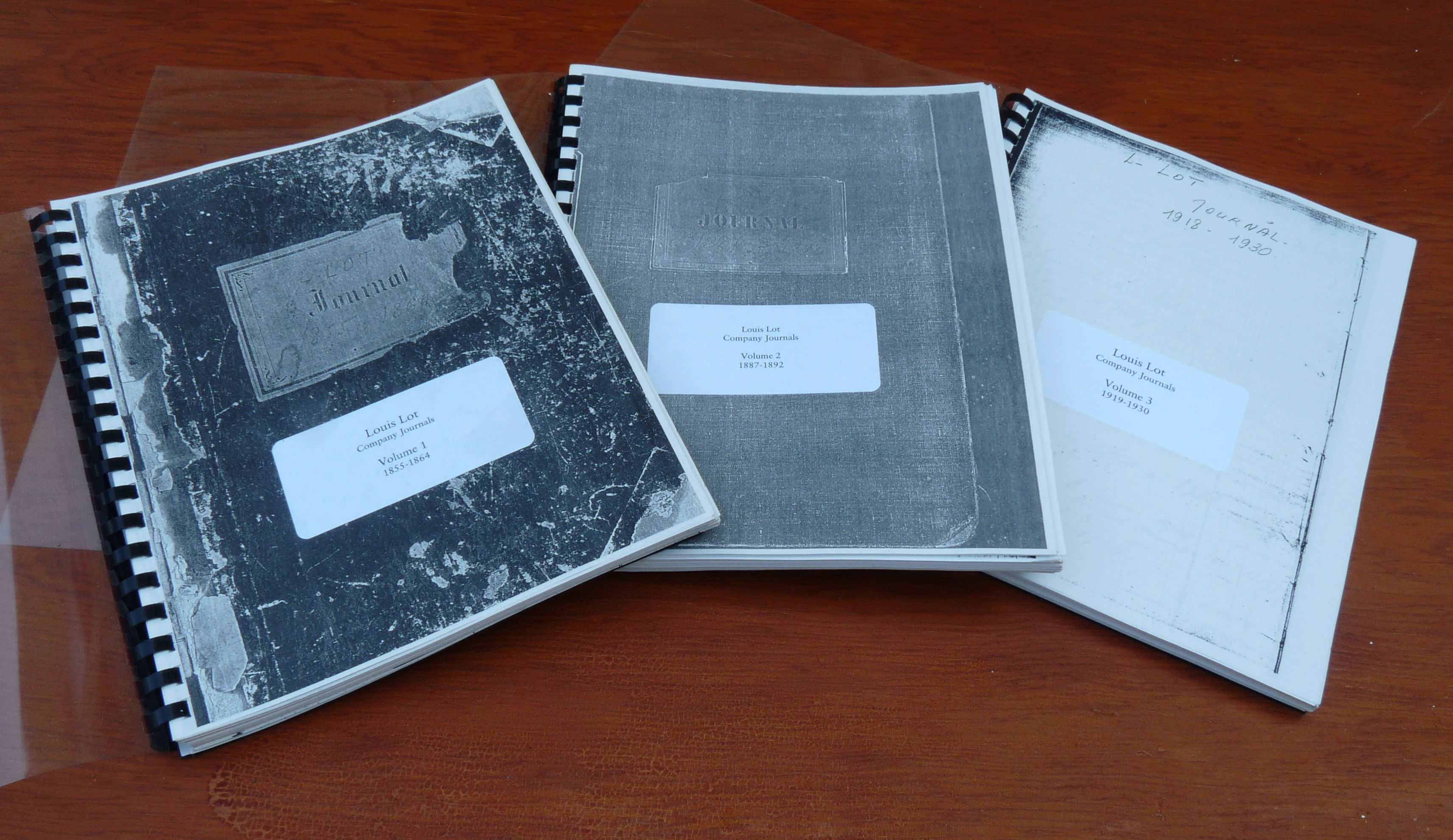
(Facsimiles of the Louis Lot company
journals.)
The journals totaled 800 pages, divided into three volumes, covering the time period from 1855-1864, 1887-1892 and 1918-1930.
My present study is centered on the first journal with records dating from March 1855 to March 1864 - the first nine years of Louis Lot’s 21-year tenure. These accounts capture daily transactions in the order they occurred before being posted into a formal ledger. Each entry records the date, customer’s name and location, a description of instruments, merchandise and/or service provided, payment terms, and amount. Although serial numbers for flutes are not consistently recorded, the total number of instruments sold appears to be nearly complete, with the exception of the missing pages for October 1858, 30 days in 1861, and December 1862.
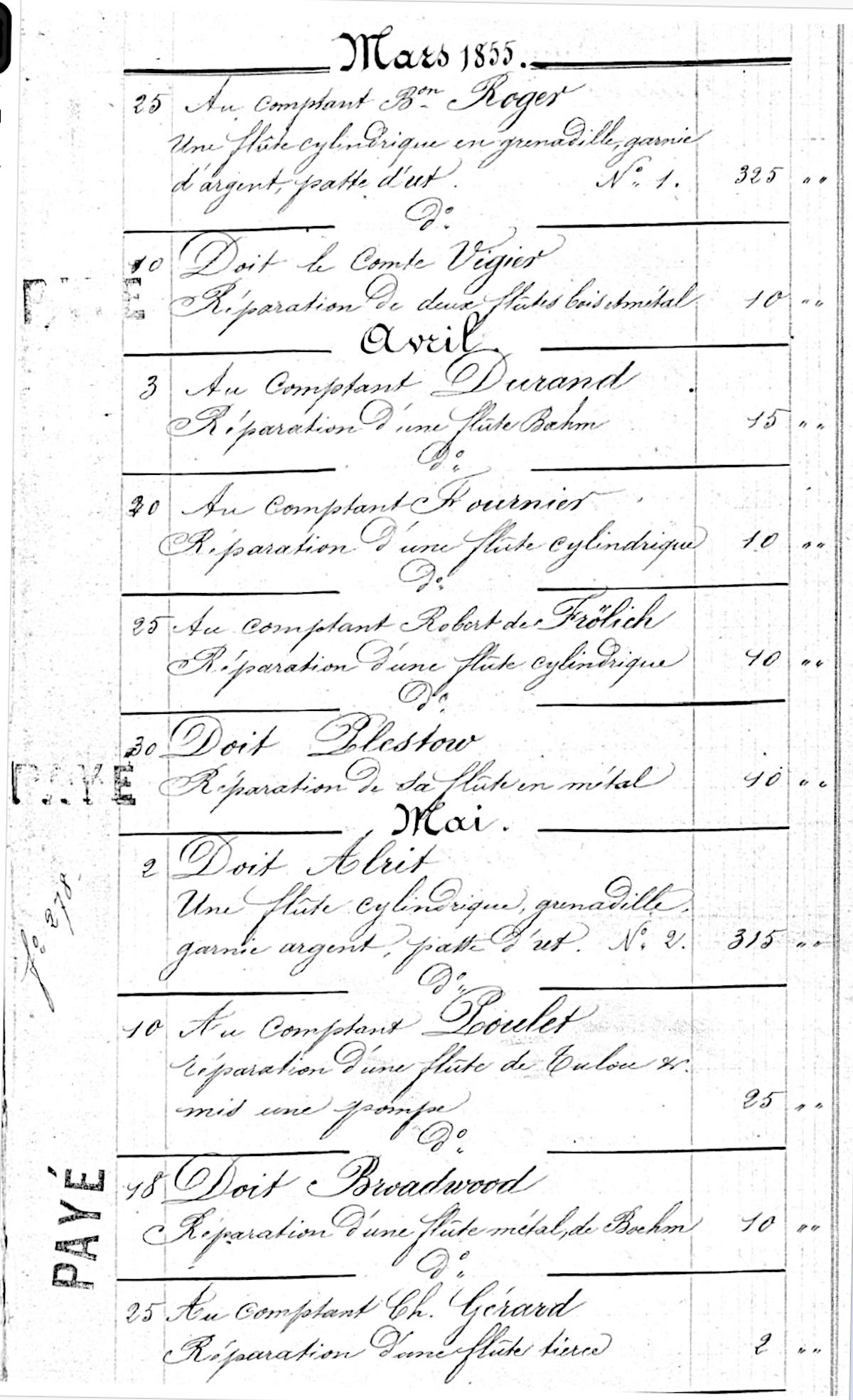
(Page one
of book one)
When Louis Lot opened his own workshop in 1855, he was almost 48 years old and already a highly experienced master flutemaker. He entered the field at a particularly dynamic moment, when numerous new systems for cylindrical flutes were being developed, including those of Carte, Clinton, Pratten, and, of course, Boehm. Rockstro and Radcliff came later.
Before establishing his own workshop, Louis Lot had worked closely with Louis Dorus, a young Parisian flutist and an early advocate of Boehm’s 1832 ring-key system for conical flutes. Given this experience, it was a natural progression for Louis Lot to manufacture and develop Boehm’s 1847 system cylindrical flutes. The 1847 system ultimately proved remarkably successful and, with only relatively minor modifications, remains the fundamental design of the modern flute we play today.
Louis Lot produced Boehm system silver and wood cylindrical flutes, conical ring-key wood flutes, Boehm piccolos, and simple-system flutes which he referred to as ordinary flutes. Below is a tabulation chart of his total production by flute type from 1855 to 1864:
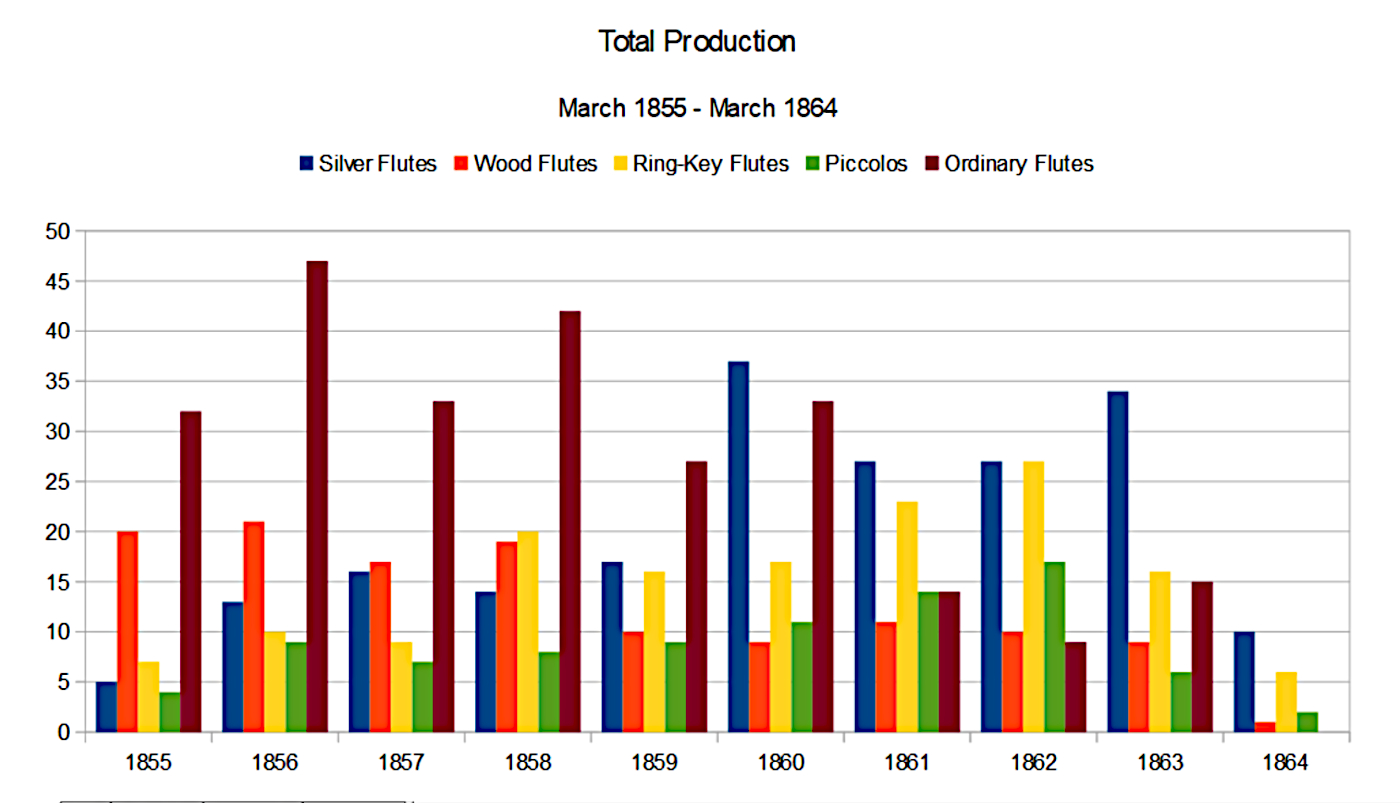
(Total yearly production
by type)
At first, silver and wood flutes were vastly outnumbered by the production of ordinary flutes. In spite of the large number of ordinary flutes sold, their revenue was only about 10% of the total revenue due to a much lower per piece price. This high volume trend, however, did not last. Production of ordinary flutes came to a halt in 1864. Surprisingly, the production of ring-key flutes continued to rise steadily through 1862. Compared to wood cylindrical flutes, a much newer product, the old-fashioned ring-key flutes were the clear winners.
Silver flutes began to establish a firm foothold around 1860, when Louis Lot became the official supplier to the Paris Conservatory. Production saw a sharp spike in 1860, and from this point onward, silver flutes would increasingly become the dominant trend.
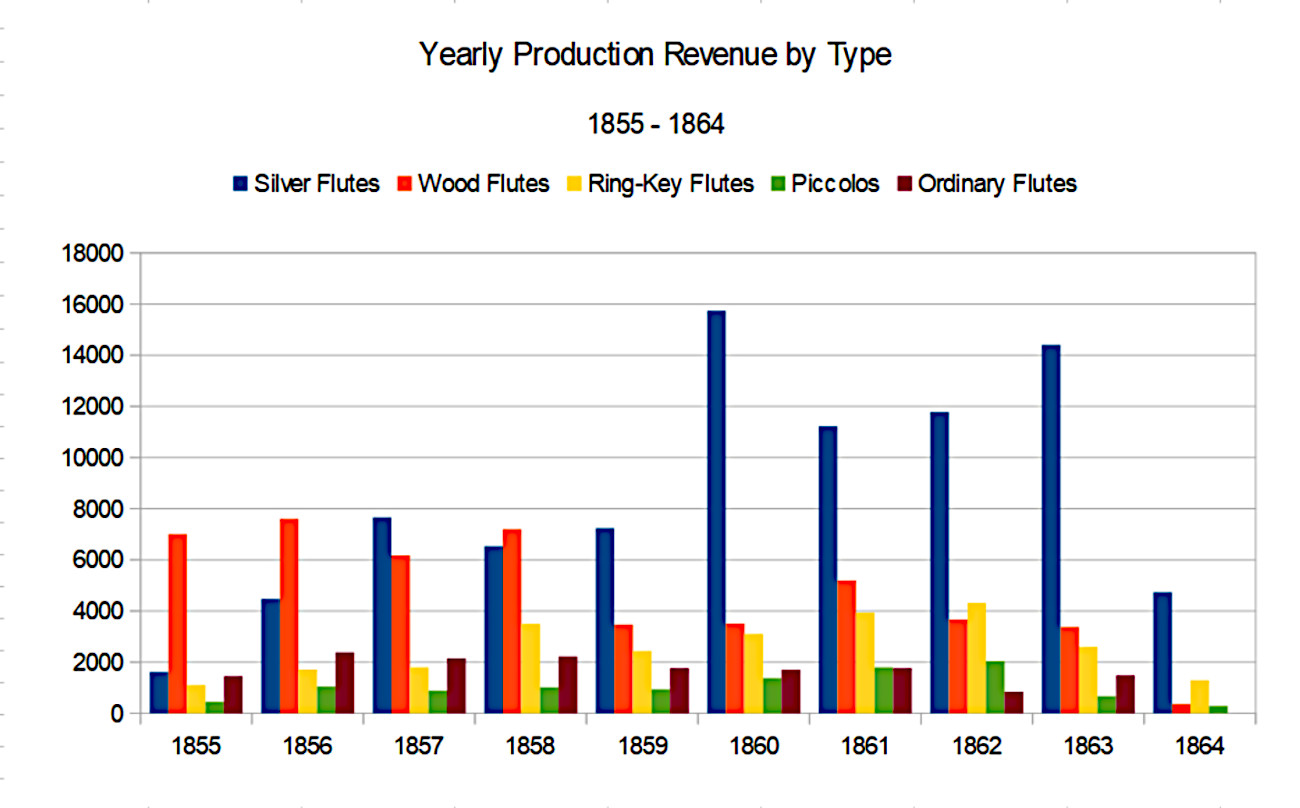
(Total yearly revenue by
type)
Looking at Louis Lot’s first 10 months of production, I found many interesting details that are worth reporting.
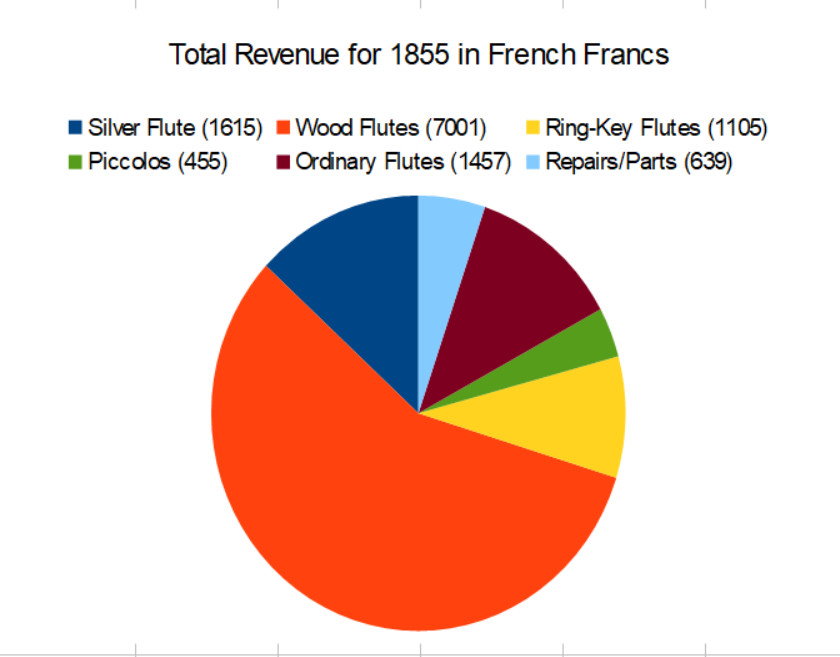
(Total revenue by type
for 1855)
The records paint a convincing picture of cylindrical wood flutes as the workshop’s bread and butter. Nineteen of the first 20 cylindrical wood flutes had silver keys, and one was even gold-plated. Three had silver lipplates, two of them engraved. The text also mentioned the use of specialty figured grenadilla wood. The immediate enthusiasm and demand for these instruments were unmistakable.
These wood instruments were purchased by professional musicians such as Antoine-Noël Alrit, Joseph-Henri Altès, Louis-Antoine Brunot, E. M. Fesser (New York), J. Élie, and Philip Ernst (New York). Many of these names may be unfamiliar to flutists today, but they were important musicians of their time. Later in this article, I will take a closer look at Louis Lot’s customers and the roles they played in the musical life of their era. The journal is filled with the names of both major and lesser-known flute celebrities.
Only five silver flutes were sold during the first 10 months, and they were equally impressive. Two were gold-plated, one was sent to Louisiana, USA, and two more were sold to Louis Dorus. One of these was purchased on behalf of Bulot d’Amiens, while the other was for Dorus himself. This would have been the very first Louis Lot silver flute Dorus used.
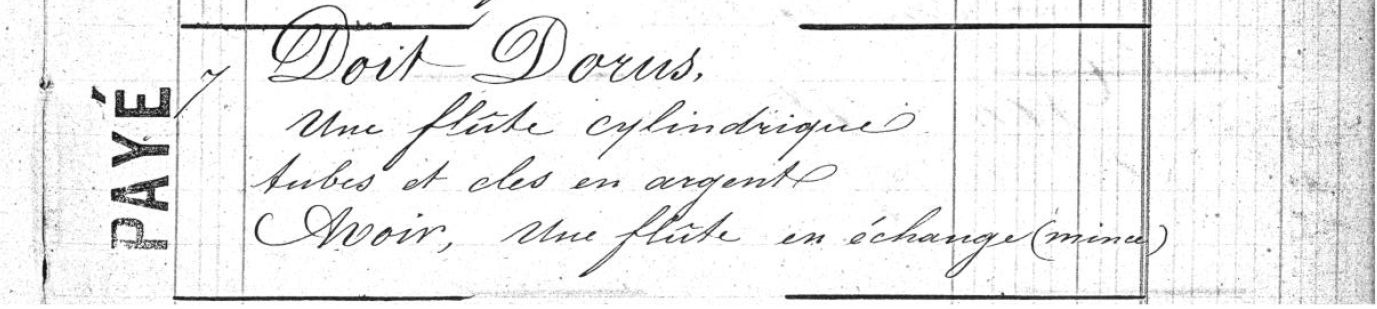
(Purchase entry of Dorus’
first Louis Lot silver flute from December 6, 1855. It was noted as an even
exchange for another flute.)
by David Chu, 2026, Maynard, Massachusetts
-
Continue to
Section 2, Catalog and Prices
Copyright
© 2026 David Chu
For more information please email Alan Weiss at alan@vintagefluteshop.com