Vintage Flute Shop
Articles
“My Notes on the Accounting Records of Louis
Lot, 1855-1864”
3. SERIAL NUMBERS
Serial numbers are not consistently included in the journal entries. The highest serial number recorded is No. 817 - a cylindrical flute, silver body and keys, new model C foot, box and accessories, cash on delivery.
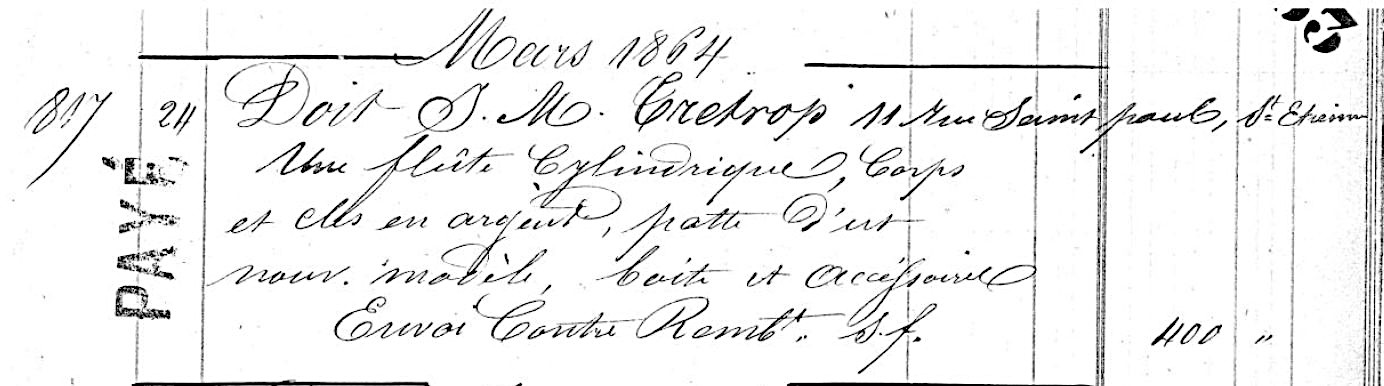
(Flute No. 817)
If one adds up the production numbers provided in Giannini’s book, the total comes to 752 instruments, which falls well short of what the highest serial number, 817, would suggest.
The following is a break down of the instruments I counted:
|
|
Total |
with s/n |
|
Wood flutes |
127 |
77 |
|
Silver flutes |
200 |
145 |
|
Ring-key flutes |
151 |
94 |
|
Piccolos |
87 |
42 |
|
Ordinary flutes |
252 |
30 |
|
Grand Total |
817 |
388 |
The evidence strongly suggests that Louis Lot's serial number system was intended to assign sequential numbers to individual instruments across the range of flutes he produced, from 5-key ordinary piccolos to silver Boehm flutes.
However, we must also consider the three months of missing accounting records, which, based on the average production rate, would represent approximately 23 instruments. When these missing instruments are taken into consideration, the discrepancy rises to roughly 23 surplus instruments against the highest serial number of 817.
Interestingly, the journal also contains 23 pairs of instruments bearing duplicate serial numbers. Had these numbers not been used twice, they would bump up the series to end at 840, making 840 the highest number in the series rather than 817. This would balance the surplus from the missing months.
|
Calculation |
Instruments |
|
Recorded production |
817 |
|
Estimated in missing 3 months |
+23 |
|
Estimated total production |
840 |
|
Highest recorded serial number |
817 |
|
Estimated missing serial numbers |
+23 |
|
Estimated highest serial number |
840 |
|
Discrepancy |
0 |
The 23 duplicate serial numbers:
Four pairs have identical descriptions, while 14 pairs appear to refer to two different types of flute. In five cases, Louis Lot himself marked the entry “(bis),” indicating that he was aware of the duplicate numbering. The flutes concerned are listed below:
Four identical pairs: 75, 80, 650, and 752.
Fourteen different types: 123, 155, 161, 166, 268, 408, 506, 541, 561, 562, 627, 705, 748, and 809.
(bis) numbers: 401, 449, 583, 807, and 816.
The total of 817 already accounts for the following two corrections.
Correction #1
The first one is most interesting because it involved Donjon and Taffanel. Flute No. 339 appears twice in the journal: first as sold to Donjon in 1859 and again to Taffanel the following year. It is possible that Donjon subsequently sold the flute to Taffanel through Louis Lot. However, it raises the question of what flute Donjon used after parting with No. 339, given that he did not buy another silver flute until 1861. He might have owned another silver flute that was not recorded as belonging to him in the journal, or he temporarily went back to using his cylindrical wood flute he bought in 1856.
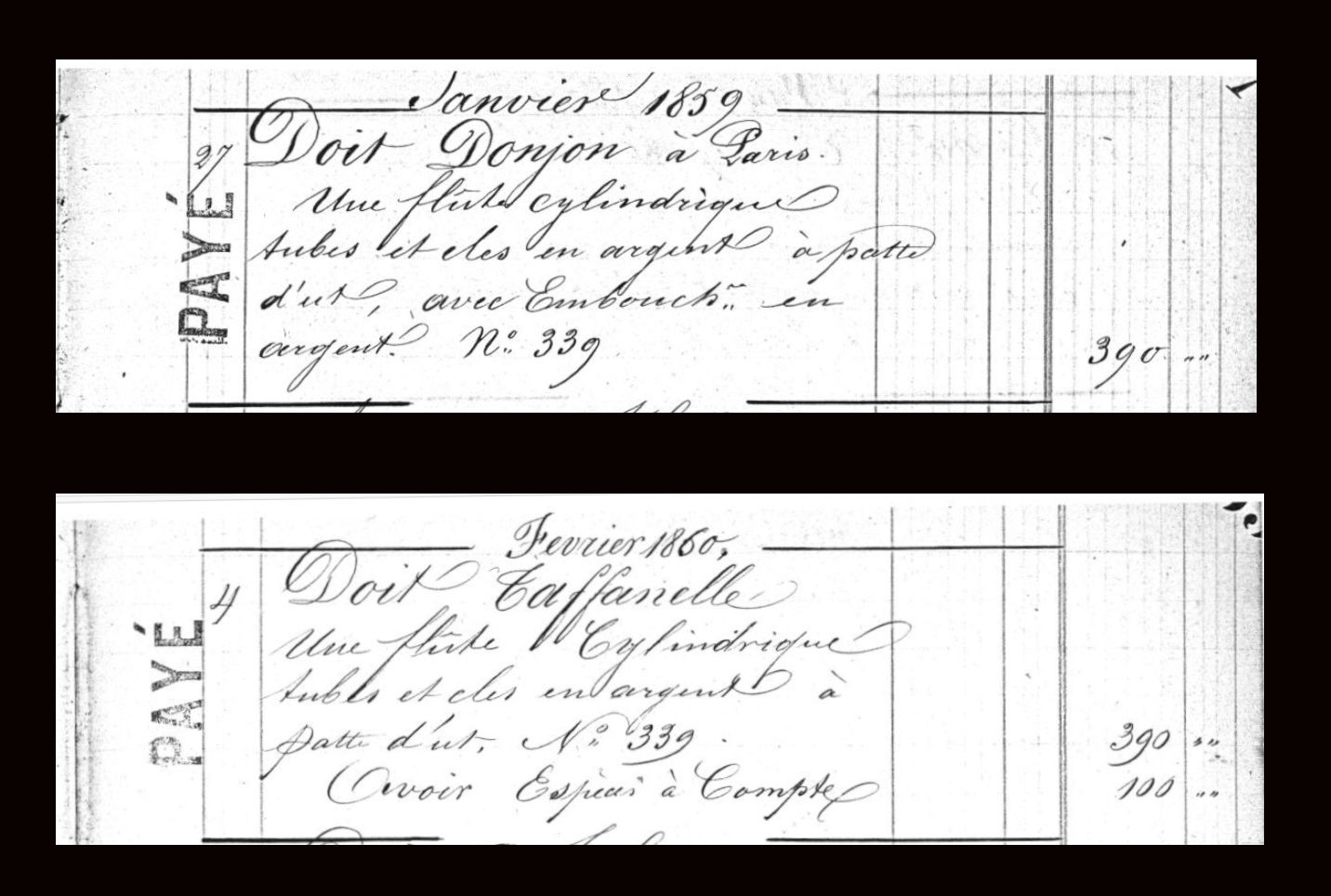
(Flute No. 339)
In Giannini’s book, Taffanel’s flute is identified as No. 439, a number that does not appear in the journal. This raises the possibility that Giannini made a typographical error - although it is also possible that she was referring to an extant flute No. 439 that belonged to Taffanel.
Correction #2
The second correction concerns ring-key flute No. 243. It was also recorded twice, with the second entry documenting the sale of the flute as a used instrument, five months after its original sale.
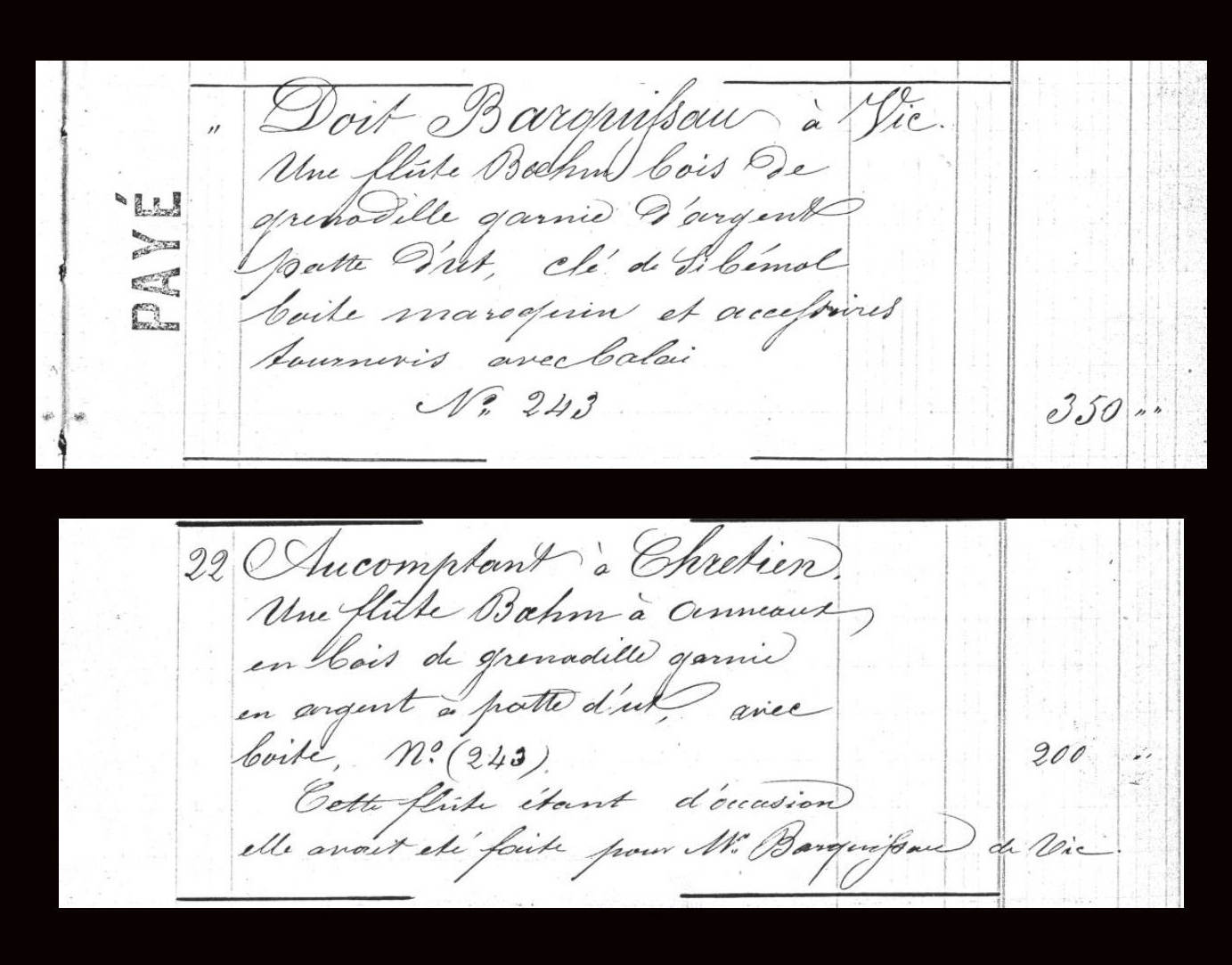
(Flute No. 243)
There are also instances among extant instruments in which serial numbers either do not appear in the journal or do not correspond to the descriptions recorded there. One such example is flute No. 261, which the journal identifies as a ring-key flute. However, the instrument preserved in the Dayton C. Miller Collection with the same number is a 5-key flute.
For the purposes of this article, I would accept the conclusion that essentially all Louis Lot instruments, from 5-key piccolos to silver Boehm flutes, were assigned a distinct serial number, at least internally, although a small number of discrepancies or duplicate numbers likely occurred. The estimated 23 missing flutes corresponding to the three missing months would account for the 23 duplicate serial numbers, effectively raising the highest serial number from No. 817 to approximately No. 840. This would, for now, balance the highest serial number with flutes produced. These notes will serve as a foundation that can be modified as new discoveries emerge.
Without belaboring the question of serial numbers, one additional point is worth noting: Louis Lot also sold 14 oboes to Rudall Rose Carte & Co., 20 wood bodies without keys to Th. Boehm, and 20 fifes. I have excluded these items from the tally because there is presently no evidence that they formed part of the serial-number sequence.
by David Chu, 2026, Maynard, Massachusetts
-
Continue to
Section 4, Old Pitch - New Pitch
Copyright
© 2026 David Chu
For more information please email Alan Weiss at alan@vintagefluteshop.com