Vintage Flute Shop
Articles
“My Notes on the Accounting Records of Louis
Lot, 1855-1864”
4. OLD PITCH – NEW PITCH
In collecting and playing vintage flutes, one important consideration is pitch. Navigating vintage flute pitch requires embracing historical context rather than trying to make the instrument conform to modern standards. For both player and collector, matching the instrument to its native pitch standard is the key to unlocking its true voice, intonation, and historical authenticity.
Louis Lot flutes made before around 1859 are almost certainly high pitch, while those made afterwards are generally low pitch. The transition, however, was not marked by a precise dividing line. The change took place over a relatively short period, within a few years of France’s official adoption of the new pitch standard in February 1859.
The new standard was legally fixed at A=435 Hz at 59°F (15°C), a rather chilly room temperature by today’s standards. A special tuning fork, known as the Diapason Normal, was produced and placed at the Paris Conservatory as the official reference.
It is important to remember that pitch is affected by temperature. A low pitch Louis Lot flute calibrated to the Diapason Normal will play noticeably higher in a warmer environment, such as 68°F (20°C). At that temperature, its effective pitch is approximately A=439 (438.75 mathematically). Thus, a flute that is correct at A=435 at the original reference temperature can naturally approach modern pitch as the playing environment becomes warmer.
There are only 23 instances in the journal that specifically mention new pitch or old pitch: nine references to new pitch and 14 to old pitch. These entries are spread across silver and wood flutes, ring-key flutes, and piccolos. Interestingly, there is no mention of a pitch standard for ordinary flutes.
The earliest recorded instance of new pitch appears on January 25, 1861, for a cylindrical wood flute with silver trim, specified as new pitch (nouveau diapason).
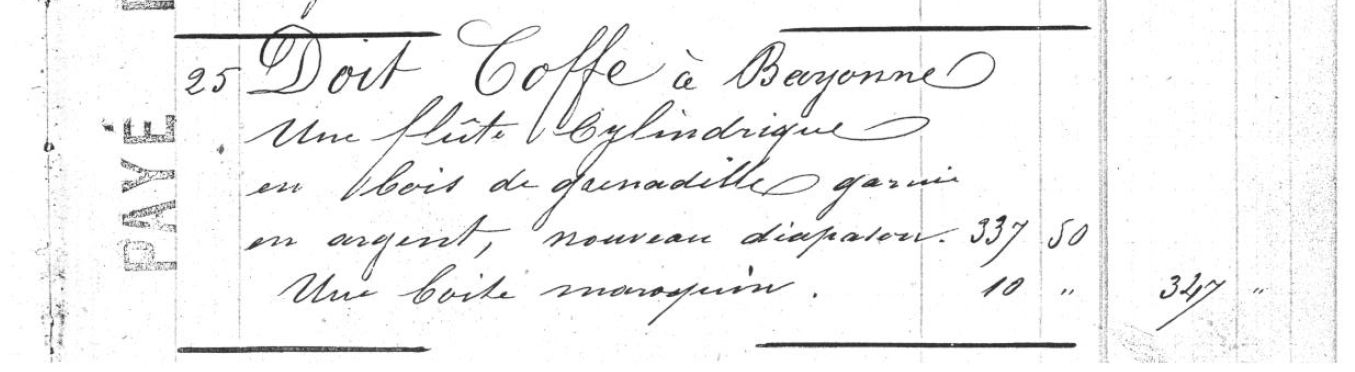
(Journal
excerpt from January 25, 1861)
Old pitch remained an option for several years after the legal adoption of the new standard. A flute sold on May 18, 1862, describes a cylindrical grenadilla flute with silver mounts and mechanism, specified as old pitch (ancien diapason).
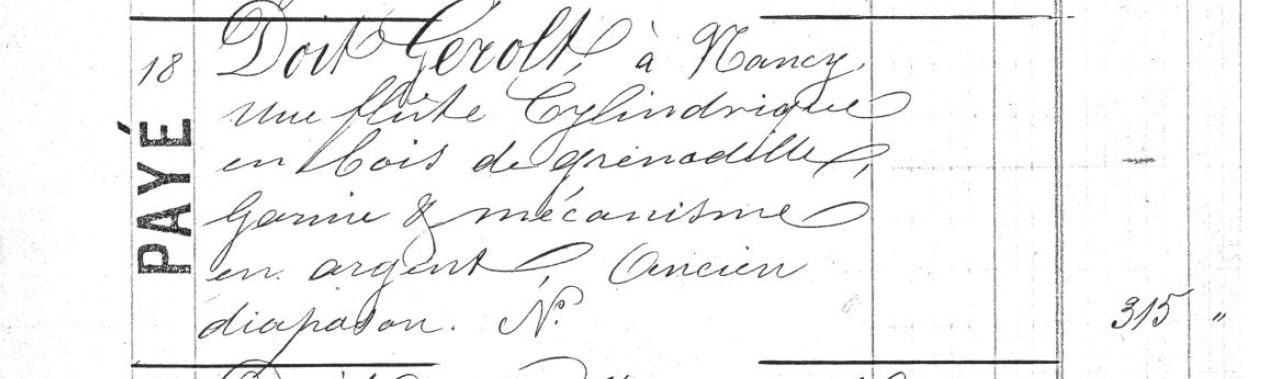
(Journal
excerpt from May 18, 1862)
The records indicate that Louis Lot continued to supply old pitch flutes for customers after the introduction of the new standard, although such instruments appear increasingly exceptional. Unless the records explicitly identify an instrument as new pitch or old pitch, there is no sure way to determine the pitch of an instrument by the manufacture date alone.
One last bit of intrigue surrounding the new pitch is that Isidor Lot, Louis Lot’s nephew, in July 1859 and Th. Boehm, in March 1860, both bought tuning forks from Louis Lot. They were 4 FF each, not an insignificant sum for a single fork. It amounts to almost 1% of the full price of a wood flute. Applied to a $16,000 modern professional silver flute, that same proportion would be close to $160. Interestingly, the 4 FF also represented approximately 1.161 grams of fine gold under the nineteenth-century French monetary standard. At today’s fluctuating gold price of around $4,500, that quantity of gold is worth roughly $167 — remarkably close to the $160 proportional equivalent.
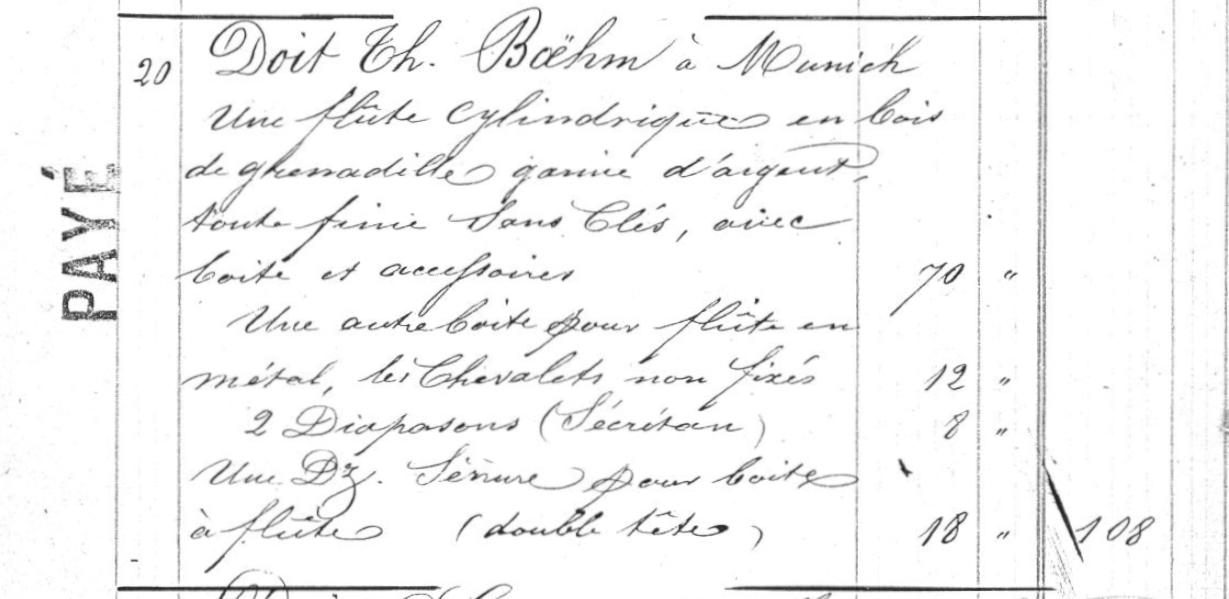
(Journal
excerpt from March 20, 1860)
The two tuning forks sold to Th. Boehm were specifically identified in the Louis Lot journal as Secrétan forks. Secrétan’s precision tuning fork was used as the reference at the Conservatoire in connection with France’s newly established Diapason Normal. Only 12 of these precision tuning forks were made. Judging by the price of 4 FF each, the two forks that Louis Lot sold to Boehm were probably made to the standard of Secrétan, but not one of the twelve. During the first year under the new pitch standard, more than 1,500 individual tuning forks were verified and distributed. The forks sold and used by Louis Lot for his own reference were likely among them.
by David Chu, 2026, Maynard, Massachusetts
-
Continue to
Section 5, Players of Silver Flutes
Copyright
© 2026 David Chu
For more information please email Alan Weiss at alan@vintagefluteshop.com