Vintage Flute Shop
Articles
“My Notes on the Accounting Records of Louis
Lot, 1855-1864”
5.
PLAYERS OF SILVER FLUTES 1
It can be overwhelming to fathom the 200 silver flutes found in the ledger that Louis Lot produced during his first nine years in business. Rather than attempting to interpret and analyze the significance of all these instruments, it may be easier to list some of the flutes bought by prominent flute players. Their instruments would provide a more tangible way of understanding the customers, the flutes they bought, and development of the flutes themselves.
I will start with Louis Dorus (1812-1896), Henri Altès (1826-1895), Johannes Donjon (1839–1912) and Paul Taffanel (1844–1908), four of the more familiar names associated with this period.
Louis
Dorus
Dorus was probably the first and most influential flute player to champion the Boehm system flutes in France. He, of course, was also the man responsible for putting the Dorus G# on just about every flute sold in France until the “independent G#” emerged as an alternative. The first recorded instance of this modification appeared in the journal on December 5, 1863 for flute No. 775.
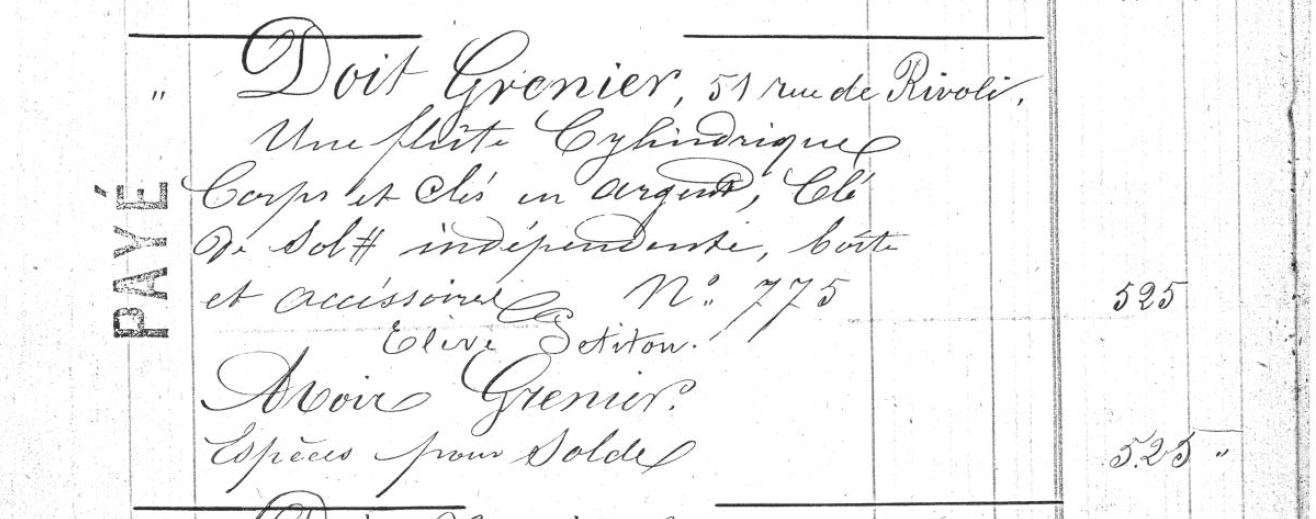
(No.
775 with independent G#)
Dorus bought the fifth silver flute Louis Lot made and four in total over a few years, they are as follows:
|
Date |
s/n |
Name |
Description |
|
12/6/1855 |
- |
Dorus |
Silver flute |
|
3/27/1857 |
169 |
Dorus |
Silver flute, gold embouchure |
|
7/20/1860 |
475 |
Dorus |
Silver flute, gold embouchure |
|
11/22/1861 |
600 |
Dorus |
Silver flute, gold embouchure |
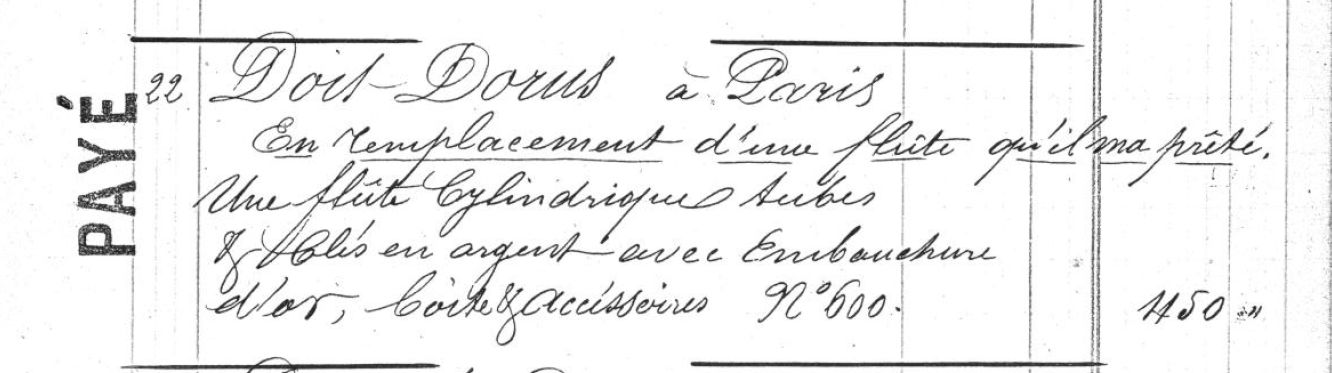
(Louis
Lot Flute, No. 600, original owner
was Dorus, and later, it became Taffanel’s flute.)
Beginning in 1835, Dorus served as solo flutist with the Orchestre de la Société des Concerts du Conservatoire, at just 23 years of age. By 1855, when Louis Lot established his workshop, Dorus had already become a highly influential figure within the flute community in France. Many of Dorus’s colleagues, associates, and students subsequently purchased instruments from Louis Lot, in part due to Dorus’ success. The following is a list of Lot’s customers who were connected with Dorus in various capacities.
Accounts in the ledgers explicitly annotated as students of Dorus:
|
Date |
s/n |
Name |
Description |
|
9/24/1855 |
25 |
Garagorri |
Ordinary flute, 8 silver keys |
|
3/27/1857 |
170 |
Brooke |
Silver flute |
|
12/10/1858 |
325 |
De Windt |
Silver flute, gold embouchure |
|
6/29/1859 |
398 |
M. Flericat |
Silver flute |
|
2/28/1862 |
629 |
d'Abaza |
Silver flute, gold embouchure |
In addition, Henry Thorpe was a student of his at the Paris Conservatory and bought a silver flute from Louis Lot a year before winning the first prize in 1861. Louis Adolph Krantz was another who won the first prize in 1867. Auguste Cantié and Jean-Firmin Brossa were two more. I will list Cantié’s flute at the end of this section and Brossa’s in Section 10, Other Makers and Innovators.
|
Date |
s/n |
Name |
Description |
|
2/9/1860 |
440 |
Thorpe |
Silver flute |
|
11/11/1863 |
- |
Krantz |
Silver flute |
Accounts associated with Dorus in some capacity:
The very first silver flute was sold to Scudamore, who was connected to Dorus through his later purchase of No. 471, an instrument delivered and paid for via Dorus. Scudamore also purchased silver flute No. 78, trading in a wood flute as part of the transaction.
|
Date |
s/n |
Name |
Description |
|
6/20/1855 |
- |
Scudamore |
Silver flute, gold-plated |
|
2/23/1856 |
78 |
Scudamore |
Silver flute |
|
6/27/1860 |
471 |
Scudamore |
Silver flute, gold embouchure |
The fourth silver flute sold was also connected to Dorus as he bought the flute on behalf of Bulot from Amiens. Bulot subsequently ordered a piccolo and another flute.
|
Date |
s/n |
Name |
Description |
|
11/20/1855 |
- |
J. Bulot |
Silver flute |
|
8/30/1856 |
- |
J. Bulot |
Boehm piccolo in D-flat |
|
9/28/1861 |
583 |
J. Bulot |
Silver flute |
Another flute whose purchase Dorus facilitated was made for Jules-Alexandre Demeur, as the record states, “par L. Dorus.” Demeur also purchased a ring-key flute a few years later. A student and later professor of flute at the Royal Conservatory of Brussels, he succeeded his teacher, Jean-François-Joseph Lahou. He traveled extensively worldwide alongside his wife, the internationally renowned singer Anne Charton-Demeur.
|
Date |
s/n |
Name |
Description |
|
8/25/1859 |
- |
Demeur |
Silver flute, gold embouchure |
|
11/20/1863 |
- |
Demeur |
Ring-key flute |
Dorus also received a large payment of 500 FF in 1859, with 4 names listed: Lepennec, Laurant, de Windt, Coizeau. As noted above, de Windt was a student of Dorus. Laurant and Coizeau both purchased flutes. Lepennec may have been misspelled in the records. An entry for M. Lepence may refer to the same individual, as the timeline is consistent with this identification.

(Entry
showing 500 FF paid to Dorus)
|
Date |
s/n |
Name |
Description |
|
12/30/1858 |
- |
M. Lepence |
Silver flute |
|
3/3/1859 |
350 |
Abel Laurent |
Silver flute, B-foot |
|
7/14/1858 |
290 |
B. Coizeau |
Silver flute, gold embouchure |
|
11/12/1858 |
316 |
B. Coizeau |
Silver flute, gold embouchure |
|
6/27/1863 |
752 |
B. Coizeau |
Silver flute |
The last significant purchase Dorus made was the acquisition of 5 maillechort flutes for the Paris Conservatory in 1860, when he became its new flute professor and Louis Lot the institution’s official flute supplier.
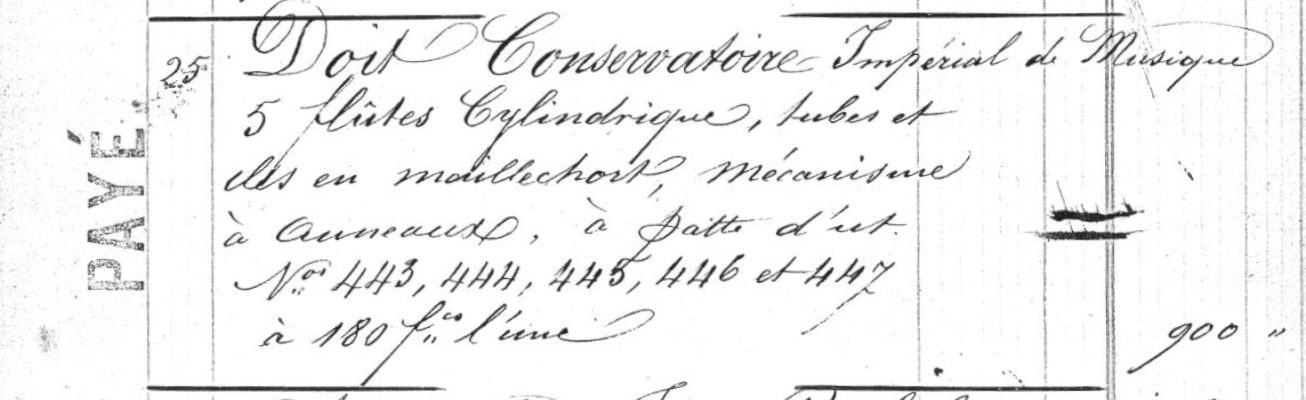
(Paris
Conservatory purchase, Nos. 443 - 447)
The 29 flutes listed above are only those with a tangible, documented connection to Dorus. There were undoubtedly many more sales that were influenced either directly or indirectly by his playing, teaching, recommendations, and professional associations. He was an important contributor to the success and development of Louis Lot’s work.
Henri
Altès
It appears that Altès acquired instruments primarily for his personal use. By the end of the first journal, his setup consisted of two piccolos and two silver flutes. In 1868, he succeeded Dorus as professor of flute at the Paris Conservatory, where he held the position for a considerably longer tenure of 25 years, compared with Dorus’s eight.
|
Date |
s/n |
Name |
Description |
|
12/20/1855 |
- |
Altès |
Boehm piccolo in C |
|
12/12/1856 |
- |
Altès |
Silver flute |
|
7/20/1857 |
476 |
Altès |
Silver flute, gold embouchure |
|
7/20/1857 |
- |
Altès |
Boehm piccolo |
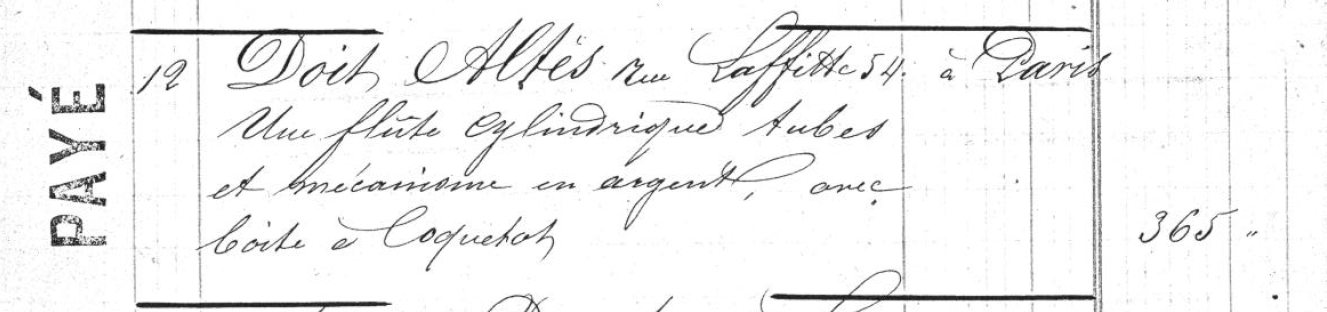
(The
first silver flute Altès bought from Louis Lot. December 12, 1856)
Johannes
Donjon
Donjon did not buy a silver Louis Lot flute until 1859 even though he bought a cylindrical wood flute in 1856, the same year he won the first prize at the Paris Conservatory. His teacher, Tulou, had strongly opposed Boehm’s invention, making Donjon’s purchase of a Boehm system flute particularly important, asserting his independence from Tulou’s preferences immediately after completing his studies.
Two of the flutes he bought were ring-key flutes for the Fathers’ College (secondary level Catholic school).
|
Date |
s/n |
Name |
Description |
|
12/17/1856 |
156 |
Donjon |
Cylindrical wood flute |
|
3/5/1858 |
260 |
Donjon |
Boehm piccolo |
|
1/27/1859 |
339 |
Donjon |
Silver flute |
|
2/51859 |
342 |
Donjon |
Boehm piccolo |
|
1/31/1860 |
437 |
Donjon |
Ring-key flute (for the Fathers’ College) |
|
4/23/1861 |
541 |
Donjon |
Silver flute |
|
6/10/1861 |
161 |
Donjon |
Ring-key flute (for the Fathers’ College) |
|
11/27/1862 |
705 |
Donjon |
Silver flute |
Donjon dedicated his 4 Pièces caractéristiques to Félix Levaigneur who bought three Louis Lot silver flutes.
|
Date |
s/n |
Name |
Description |
|
11/30/1857 |
230 |
Levaigneur |
Silver flute, gold embouchure |
|
7/15/1862 |
- |
Levaigneur |
Silver flute, gold embouchure |
|
7/15/1862 |
- |
Levaigneur |
Silver flute, old pitch |
Paul
Taffanel
Taffanel was only 20 years old when the first Louis Lot journal concluded. In 1860, during Dorus’ first year of teaching at the Paris Conservatory, Taffanel was his first student to win the first prize. Taffanel’s father, Jules, was also a flute player. A picture in Blakeman’s book on Taffanel shows 10-year-old Taffanel holding a cylindrical Boehm system wood flute, and his father holding a conical flute with ring keys.
The flute most closely associated with Taffanel is Louis Lot No. 600, which had previously been played by Dorus. It is famously depicted in a photograph of Taffanel holding the instrument, reproduced on the back cover of his 17 Daily Exercises, published by Leduc in the 1970s.
The Louis Lot journal records only one flute, one headjoint, and two repairs associated with Taffanel’s name, which was initially misspelled in the journal.
|
Date |
s/n |
Name |
Description |
|
2/4/1860 |
399 |
Taffanelle |
Silver flute |
|
12/10/1860 |
- |
Taffanel |
Silver headjoint, gold embouchure |
|
1/25/1861 |
- |
Taffanel |
Overhaul his silver flute, repaired his wood flute |
One of Taffanel’s students also bought a flute, a very expensive instrument priced at 800 FF.
|
Date |
s/n |
Name |
Description |
|
1/3/1862 |
- |
Letord |
Silver flute, gold embouchure and gold rings |
An important figure in Taffanel’s formative years in Bordeaux was Paul Guercy, who introduced the young Taffanel to Dorus. Guercy was also a valued customer of Louis Lot, having purchased five flutes and one headjoint. Dorus’ L'étude de la nouvelle flute was dedicated to him.
|
Date |
s/n |
Name |
Description |
|
1/5/1856 |
94 |
Guercy |
Ring-key flute (For the account of Dufau) |
|
8/29/1857 |
- |
Guercy |
Silver flute, gold embouchure |
|
11/27/1862 |
703 |
Guercy |
Silver flute, guillochée lipplate (for Philharmonic Society) |
|
11/6/1863 |
773 |
Guercy |
Silver flute |
|
1/15/1864 |
801 |
Guercy |
Silver flute, guillochée lipplate |
|
1/15/1864 |
- |
Guercy |
Silver headjoint, guillochée lipplate |
Louis Lot and Godfroy held the monopoly on the production of 1847 system Boehm flutes in France until 1862. During this period, the development of the instruments and the French school of flute playing progressed hand in hand, each influencing and shaping the other. The following are a few more prominent Louis Lot artists who occupied important playing positions in Paris. By the end of the first journal, Louis Lot was already well on his way to writing his own chapter in the history of the flute.
In Paris there were many opportunities to play the flute professionally. In addition to the Société des Concerts du Conservatoire, associated with the Paris Conservatory, there were the Théâtre Impérial de l’Opéra (Paris Opera), the Opéra-Comique, the Théâtre-Italien, and the Théâtre-Lyrique, all within a short walking distance of one another. The following Louis Lot customers played silver flutes and were active in this musical circle: Victor Petiton, Louis-Antoine Brunot, Jean-Baptiste Laflorance, and Auguste Cantié.
|
Date |
s/n |
Name |
Description |
|
6/20/1857 |
192 |
Petiton |
Silver flute |
|
5/15/1858 |
28 |
Petiton |
Silver flute |
|
9/16/1857 |
- |
Brunot |
Silver flute, gold embouchure |
|
10/15/1860 |
- |
Brunot |
Silver flute, gold embouchure |
|
1/27/1859 |
338 |
Laflorance |
Silver flute |
|
6/18/1861 |
748 |
Laflorance |
Silver flute |
|
3/8/1860 |
- |
Cantié |
Silver flute |
One other acclaimed flutist in Paris was Giuseppe Gariboldi. He moved to Paris from Italy in 1856. Gariboldi wrote a surprisingly large number of études and exercises for flute published in various collections. His silver flute was No. 400, the only Louis Lot he bought.
|
Date |
s/n |
Name |
Description |
|
7/23/1859 |
400 |
Gariboldi |
Silver flute |
The first journal contains records of many additional flute players who purchased silver Louis Lot flutes. These players, along with their instruments, will be discussed in Section 7, Players of Silver Flutes 2.
by David Chu, 2026, Maynard, Massachusetts
-
Continue
to Section 6, Maillechort
Copyright
© 2026 David Chu
For more information please email Alan Weiss at alan@vintagefluteshop.com