Vintage Flute Shop
Articles
“My Notes on the Accounting Records of Louis
Lot, 1855-1864”
6. MAILLECHORT
Maillechort (German silver or nickel silver) was developed and patented in France by Maillot and Chorier around 1827-1829. It is an alloy of copper, nickel, and zinc, typically in a ratio of about 60:20:20. The exact formula can vary. A flute made of maillechort will feel noticeably lighter in the hand than a silver instrument and it will cost less.
In addition to silver, Louis Lot offered flutes and keywork in maillechort from the very beginning. The price differential between flutes with silver keys and maillechort keys was approximately 25% for cylindrical wood flutes, 30% for metal flutes, more than 35% for ring-key flutes, and a staggering 65% for ordinary flutes. Despite the lower price, however, Louis Lot found no takers for its maillechort metal flute until 1860, when the Paris Conservatory purchased five in a single order, Nos. 443–447.
Even after this initial breakthrough, sales of maillechort flutes remained slow compared with those of silver flutes. Only 12 additional maillechort flutes were sold over the following three years, while silver flutes outsold maillechort by a ratio of roughly 6 to 1 during the same period.
One important feature that Louis Lot incorporated into its maillechort flutes was a solid silver lipplate. Many later maillechort flutes by other makers, such as Bonneville and Rive, were silver-plated and almost never fitted with solid silver lipplates. In hindsight, Louis Lot made a particularly practical choice. Unlike a silver-plated maillechort lipplate, which can develop unsightly wear around the edge of the embouchure hole as the plating wears away, a solid silver lipplate does not suffer from this problem. Whether the silver lipplate has any effect on the sound is a question for another time.
Of the 17 maillechort flutes recorded in the journal, only eight are documented as having solid silver lipplates. One even had a gold lipplate, No. 592. It was made for Giulio Briccialdi, the celebrated Italian flautist and composer credited with the invention of the Bb thumb key that bears his name. He bought another flute earlier, also with a gold lipplate.
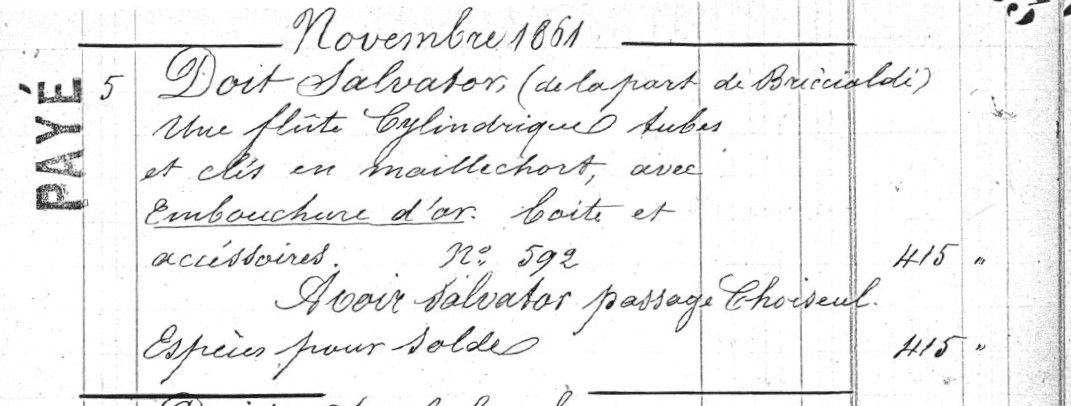
(Briccialdi’s
maillechort flute with gold lipplate, No. 592)
|
Date |
s/n |
Name |
Description |
|
12/30/1857 |
214 |
Briccialdi |
Silver flute, gold embouchure |
|
11/05/1861 |
592 |
Briccialdi |
Maillechort flute, gold embouchure |
Maillechort has a slippery feel to the touch and lacks the tactile character of silver unless it is silver-plated. The five flutes sold to the Paris Conservatory make no mention of silver-plating or solid silver lipplates. However, the next maillechort flute recorded by Louis Lot had both, establishing what would eventually become the standard issue for the maillechort Louis Lot flutes that followed. The plating work was itemized at 20 FF extra. Four additional flutes in the journal are specifically noted as silver-plated, and one was even gold-plated. The latter was exhibited at the 1862 International Exhibition in London. The gold-plated maillechort flute sold for 500 FF, same as the list price of a solid silver flute before any discount.
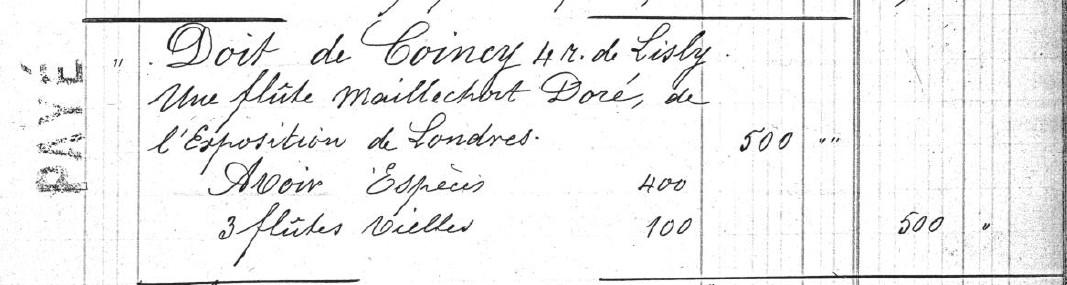
(Entry
for gold-plated maillechort flute)
Silver- and gold-plating in France was largely the domain of Charles Christofle. In 1842, he obtained a 15-year license for electrolytic plating. At the time, electricity was supplied by large chemical batteries capable of generating the low-voltage, continuous direct current required for electrolysis.
As a flute restorer, I often find that the silver-plating on Louis Lot flutes has a different feel from the modern plating found on inexpensive student instruments. One possible explanation is the rate of deposition. Christofle would have worked with considerably lower current densities requiring a much longer plating time than is readily achievable with modern equipment. This was not a matter of preference, but of technological necessity: electricity was not yet a readily available commodity.
The same principle applies to other aspects of Louis Lot’s flute construction. The use of seamed tubes was not necessarily a choice based on superior acoustic properties; rather, drawn tubing had not been invented yet. What we may now regard as a deliberate design choice was often simply a consequence of the technology available at the time.
In Giannini’s book, she notes that the inventory of Vincent-Hippolyte Godfroy, drawn up after his death in 1868, listed an outstanding debt of 32.60 FF owed to Christofle. This establishes that Christofle was Godfroy’s plater and strongly suggests that he might also have provided plating services for Louis Lot.
Louis Lot’s manufacture of Boehm-system flutes and its application of electroplating placed the firm at the forefront of industrial production. Although we now regard these instruments as vintage, they were the products of a forward-thinking company that embraced some of the most advanced manufacturing technologies of its time.
by David Chu, 2026, Maynard, Massachusetts
-
Continue to
Section 7, Players of Silver Flutes 2
Copyright
© 2026 David Chu
For more information please email Alan Weiss at alan@vintagefluteshop.com