Vintage Flute Shop
Articles
“My Notes on the Accounting Records of Louis
Lot, 1855-1864”
7. PLAYERS OF SILVER
FLUTES 2
Another way of exploring some of the remaining Louis Lot silver flutes is to consider them geographically. I will look at them by city in order of their population size given in the 1861 census. I have chosen to focus only on the cities with the most engaging narrative — places where the records reveal particularly interesting connections between musicians, instruments, and the broader development of the flute. Because sales locations are not always recorded in the journal, the calculated figures underrepresent the actual number of flutes shipped.
Lyon
(pop. 292,721)
Jean-François Nauwelaers, flutist in the Lyon Theatre Orchestra, was by far the region’s largest customer, purchasing about 30 of the more than 40 Louis Lot instruments shipped to Lyon. These shipments consisted mostly of conical ring-key flutes, reflecting Lyon’s relatively late adoption of metal instruments and the continued popularity of conical flutes.
Nauwelaers purchased his first silver flute in 1863. Ten months later, a second maillechort flute was purchased by a certain Bonnardon. These early purchases provide an interesting glimpse into the gradual transition from wood to metal flutes in Lyon, as players began to experiment with the newer instruments alongside the older French flute tradition.
|
Date |
s/n |
Name |
Description |
|
2/23/1863 |
721 |
Nauwelaers |
Silver flute |
|
12/27/1863 |
789 |
Bonnardon |
Silver-plated maillechort flute |
Marseille
(pop. 260,910)
Louis Lot silver flutes were considerably more successful in Marseille, where Simon Lauret and Émile Astruc were the two most prominent flute figures. Lauret was one of Louis Lot’s most important customers. The first journal indicates that he purchased more than 35 flutes of various types, including 11 silver flutes. His network among Marseille’s flutists must have been extensive. He was professor of flute at the Marseille Conservatory and may also have performed at the Grand Théâtre de Marseille, further extending his connections within the city’s musical establishment.
Émile Astruc, meanwhile, was principal flutist of the Grand Théâtre de Marseille and another important Louis Lot customer. He purchased nine instruments from the firm, three of which were silver flutes. The purchases of Lauret and Astruc suggest that Louis Lot had established a particularly strong presence among Marseille’s leading professional flutists, with silver instruments finding a much more receptive market there than in Lyon.
|
Date |
s/n |
Name |
Description |
|
6/3/1856 |
- |
Lauret |
Silver flute |
|
8/18/1856 |
116 |
Lauret |
Silver flute |
|
8/30/1856 |
123 |
Lauret |
Silver flute, B-foot |
|
4/27/1859 |
372 |
Lauret |
Silver flute |
|
9/30/1859 |
408 |
Lauret |
Silver flute |
|
6/30/1860 |
472 |
Lauret |
Silver flute, B-foot |
|
10/28/1861 |
590 |
Lauret |
Silver flute |
|
3/20/1862 |
627 |
Lauret |
Silver flute |
|
5/1/1863 |
742 |
Lauret |
Silver flute, guillochée lipplate |
|
6/12/1863 |
746 |
Lauret |
Silver flute, guillochée lipplate |
|
6/30/1863 |
752 |
Lauret |
Silver flute, guillochée lipplate |
|
5/10/1856 |
101 |
Astruc |
Silver flute |
|
8/18/1860 |
482 |
Astruc |
Silver flute |
|
5/1/1863 |
744 |
Astruc |
Silver flute, guillochée lipplate |
The four flutes purchased by the two men in May and June 1863 are of particular interest. All four feature guillochée lipplates. The first reference to guillochée in the journal appears on May 14, 1862, for flute No. 649. Among these 1863 orders, Astruc and Lauret each commissioned a flute with the new pitch and an old G# (Dorus) key.
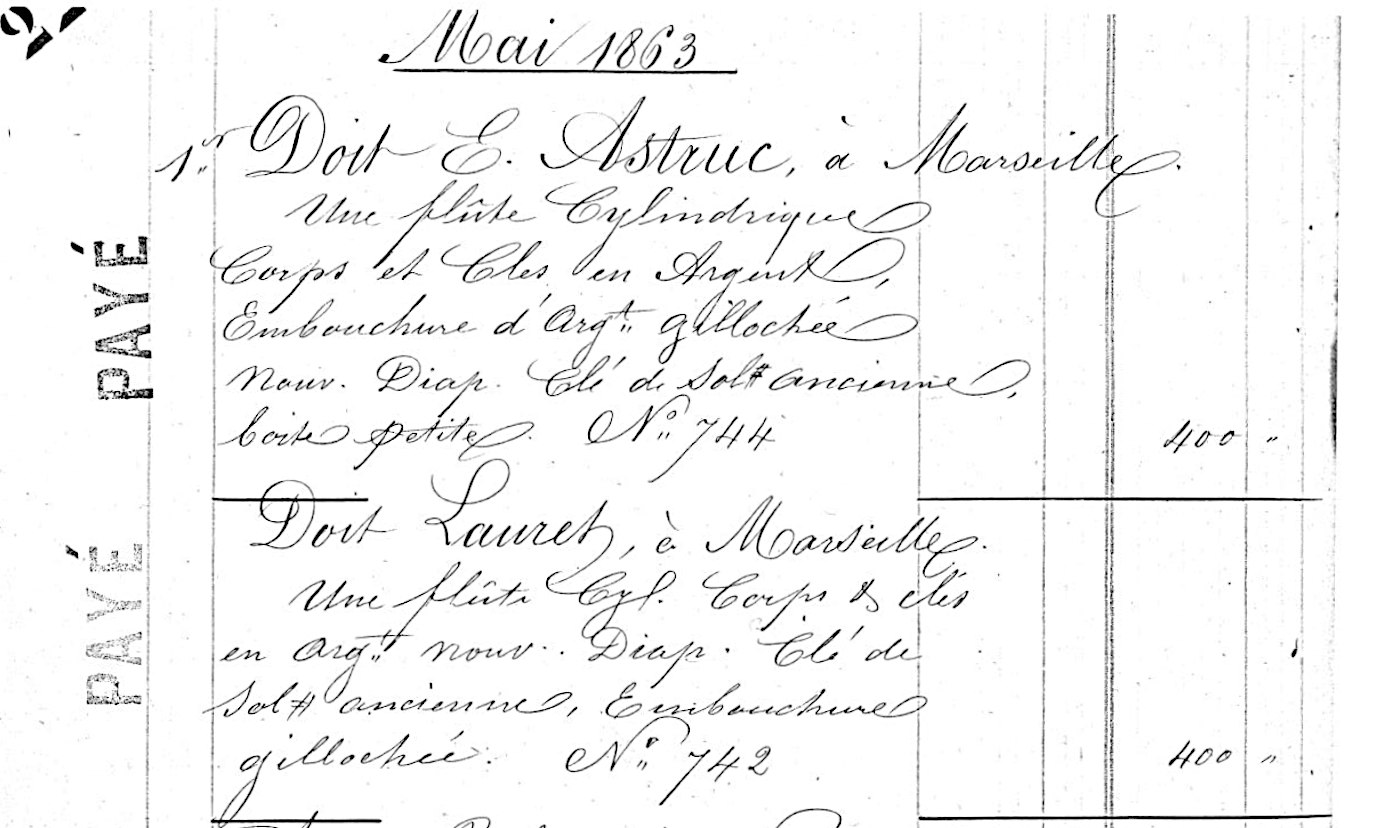
(Nos.
744 and 742, new pitch and old G#)
Bordeaux
(pop. 162,750)
Bordeaux was Taffanel’s hometown, and an important figure during his formative years was Paul Guercy, whose four silver flutes were listed in the previous section. In addition to Guercy’s instruments, only three other silver flutes were dispatched to Bordeaux during this period, destined for three other individuals: Alexandre Dufau, Nelson Vène, and Jules Laronde.
Dufau was a student of Guercy, while Vène appears to have been connected with Dufau, as the two share an account entry. Vène’s flute was the first instrument listed in the journal to have a guillochée lipplate. Both Dufau and Vène also purchased Louis Lot ring-key flutes and Boehm-system piccolos. Clearly, they were good customers.
|
Date |
s/n |
Name |
Description |
|
9/12/1857 |
- |
Dufau |
Silver flute |
|
8/14/1858 |
300 |
Laronde |
Silver flute |
|
5/14/1862 |
648 |
Vène |
Silver flute, guillochée lipplate, gold rings |
Lille
(pop. 131,727)
There was only one Louis Lot customer recorded in Lille, but he was an important one: Jules Herman. Herman performed at the Théâtre and taught at the Conservatory, making him a major figure in Lille’s musical life. He was also the first to transcribe Paganini’s 24 Caprices for flute, an arrangement that remains widely available today through the International Music Company in an edition by John Wummer.
Herman purchased a silver flute from Louis Lot in 1861 and, a year later, a cylindrical wood flute. In doing so, he had embraced both sides of the flute world of the period — taking advantage of the projection of the silver instrument while retaining the distinctive character of the traditional wood flute.
|
Date |
s/n |
Name |
Description |
|
6/10/1861 |
559 |
Herman |
Silver flute |
|
11/04/1862 |
705 |
Herman |
Cylindrical wood flute |
Toulouse
(pop. 126,936)
Louis Lot’s principal advocate in Toulouse was Joseph-Jean Fournez, who purchased 13 instruments from the firm, mostly ring-key flutes, along with three silver flutes. His flute-buying pattern reflects a methodical experimentation with the new flutes in the region.
|
Date |
s/n |
Name |
Description |
|
8/22/1860 |
483 |
Fournez |
Silver flute |
|
11/5/1860 |
501 |
Fournez |
Silver flute |
|
7/19/1862 |
- |
Fournez |
Silver flute |
Le
Havre (pop. 74,336)
Charles Herval was a flute teacher in Le Havre. He may have also been involved with the Grand Théâtre, as he paid Louis Lot for a repair of a Godfroy wood flute that belonged to the Théâtre in 1862.
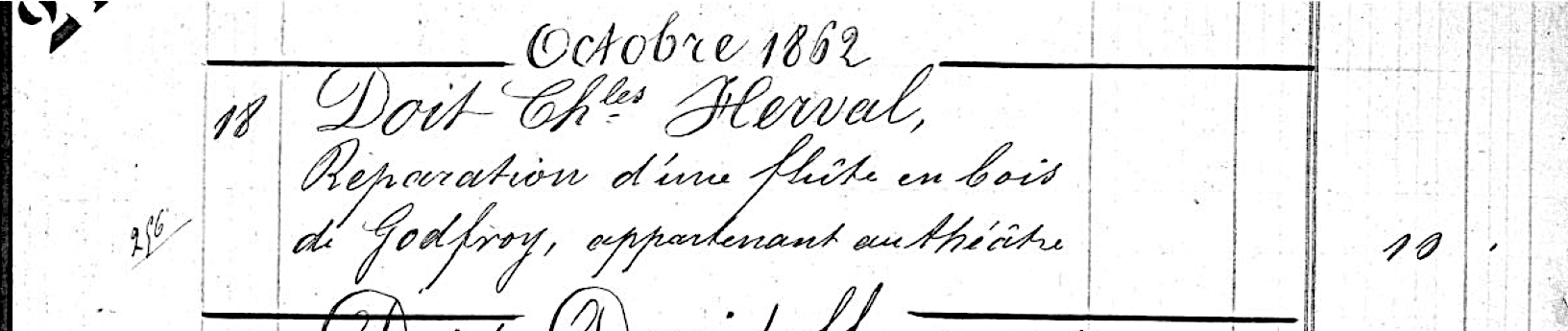
(Repair
of a Godfroy wood flute)
Louis Lot shipped many instruments to Le Havre, including eight cylindrical wood flutes, six metal flutes, two piccolos, a 5-key flute, and three headjoints. Herval was responsible for all six metal flutes.
|
Date |
s/n |
Name |
Description |
|
3/18/1858 |
- |
Herval |
Silver flute |
|
1/13/1860 |
- |
Herval |
Silver flute, gold embouchure |
|
5/7/1860 |
456 |
Herval |
Silver flute, gold embouchure |
|
11/18/1860 |
502 |
Herval |
Silver flute, gold embouchure |
|
6/24/1861 |
561 |
Herval |
Silver flute, gold embouchure |
|
2/15/1862 |
628 |
Herval |
Maillechort flute, silver embouchure |
Strasbourg
(pop. 74,307)
There was only one purchase from Strasbourg: a Conservatory student named Krantz, who won the first prize in 1867.
|
Date |
s/n |
Name |
Description |
|
11/11/1863 |
777 |
Krantz |
Silver flute |
Nancy
(pop. 49,305)
M. Gérolt was a prominent flutist and composer active in Nancy’s musical life. He purchased nine Louis Lot flutes, including one silver flute, one ordinary flute, one ring-key flute, and six cylindrical wood flutes. This suggests that Nancy had a strong preference for the 1847 system flute, in contrast to cities such as Lyon, where 1832 system ring-key flutes predominated.
|
Date |
s/n |
Name |
Description |
|
12/16/1861 |
608 |
Gérolt |
Silver flute |
Nice
(pop. 48,273)
There was relatively little activity in Louis Lot flute sales in Nice, with only five flutes shipped there. However, four of these were cylindrical 1847 system flutes: three in silver and one in wood. Two of the silver flutes went to André Lemort, while the third went to Eugène Barlet. Lemort received a discount of only about 10 percent, while Barlet paid nearly the full price. This may suggest that neither was a particularly prominent player or teacher.
|
Date |
s/n |
Name |
Description |
|
9/4/1860 |
486 |
Lemort |
Silver flute, gold embouchure |
|
11/20/1861 |
598 |
Lemort |
Silver flute, new pitch |
|
4/5/1862 |
- |
Barlet |
Silver flute |
by David Chu, 2026, Maynard, Massachusetts
-
Continue to
Section 8, Cylindrical Wood Flutes
Copyright
© 2026 David Chu
For more information please email Alan Weiss at alan@vintagefluteshop.com