Vintage Flute Shop
Articles
“My Notes on the Accounting Records of Louis
Lot, 1855-1864”
8. CYLINDRICAL WOOD
FLUTES
Boehm put his 1847 system on a cylindrical metal flute first, not on wood. Had it been the other way around, the metal flute might have had a different fate.
Louis Lot made three cylindrical wood flutes before making his first silver flute. He went on to make six more wood flutes before producing his second silver flute. The ratio of wood to silver flutes was 20 to 5, as recorded in the journal for the year 1855.
When
comparing Louis Lot’s production of silver flutes and wood flutes, one also has
to consider that there are two different kinds of wood flutes, conical and
cylindrical, as well as simple-system flutes. Louis Lot produced a great number
of simple-system flutes even though their revenue was small because of their
much lower unit price. From the graph below, one can see that cylindrical wood
flute production was strong in the beginning, but gave way to silver flutes
within just a few short years.
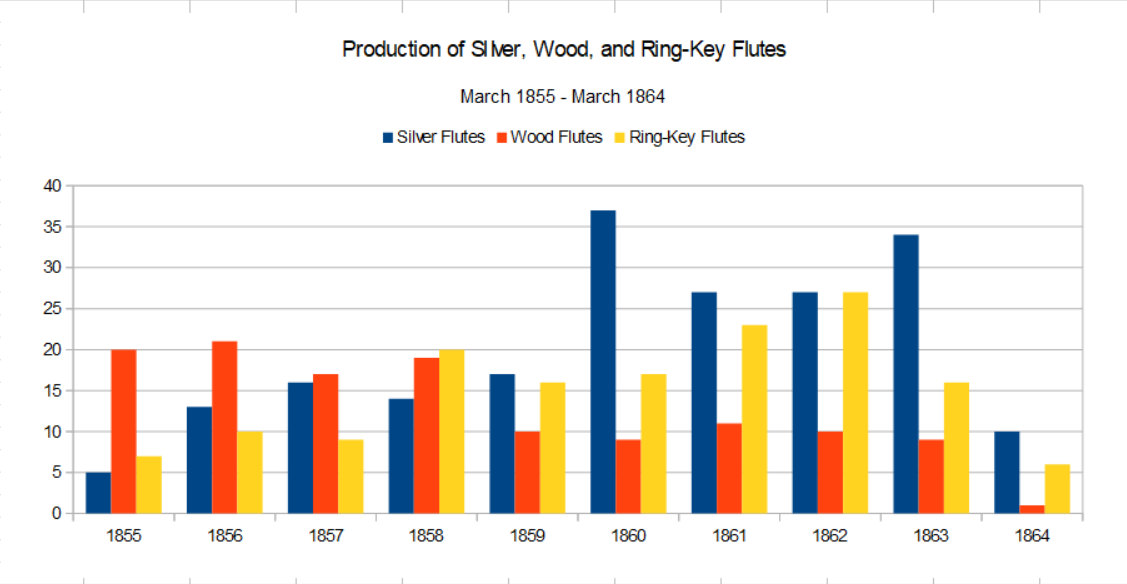
(Production
of silver, wood and ring-key flutes)
In 1855, cylindrical wood flutes bridged the gap between the 1832 system conical wood Boehm flute and the 1847 system silver Boehm flute. Acoustically, they were much closer to the silver flutes, but materially and aesthetically, they remained closer to the ring-key flutes. They offered an alternative way of adopting Boehm’s 1847 acoustical innovation without accepting the cultural and tonal break represented by the metal instrument.
In Louis Lot’s 1855 catalog, the first option is for a silver lining (doublage) of the headjoint for cylindrical wood flutes at 30 FF extra. Most English wood flutes have standard metal-lined headjoints intended for a stronger sound, but they are prone to cracking due to the different rates of expansion between metal and wood. Just over one-third of the wood flutes Louis Lot sold included this option. The fourth option is for a silver lining of the entire flute for 50 FF. Only three customers opted for it: the buyers of flute Nos. 218, 278, and 465. No. 465 was sold to Buffet Leroy & Goumas, and its lining was made of maillechort rather than silver, perhaps because of its lighter weight.
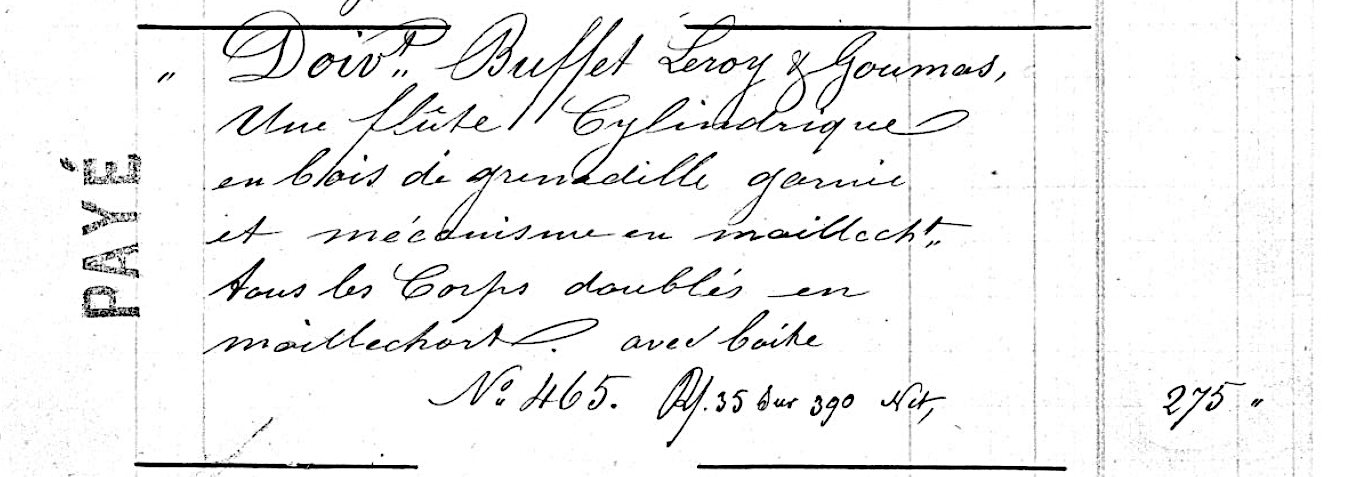
(No.
465, Buffet’s order with lined maillechort)
A silver lipplate, however, was not listed as an option in the 1855 catalog. The production journal records lipplates on 11 wood flutes, nine of which were engraved. These appear to have been reserved for cylindrical flutes. None of the conical flutes were made with a lipplate.
A B-footjoint on a Louis Lot wood flute is quite rare, with only 17 customers ordering them across the entire production journal. Eight of these customers were from New York, potentially marking the beginning of a national preference. There are even fewer examples among the silver flutes, only 15 out of 200 instruments were ordered with a B-foot.
Most of the cylindrical wood flutes have silver keys, with only 18 having maillechort keys. The situation is reversed for ring-key wood flutes: most have maillechort keys, while only 20 have silver keys. The price list shows that, for a C-foot cylindrical wood flute, the silver-key version is only 100 FF more than its maillechort-key counterpart, whereas the difference for a ring-key wood flute is 150 FF.
The disparity becomes even more striking when expressed as a percentage of the base price. Upgrading from maillechort keys to silver keys represents a 29% increase for the cylindrical wood flute, while the same upgrade represents a 60% increase for the ring-key flute. Perhaps this explains why so few flutists were willing to pay the substantial premium for a ring-key flute with silver keys.
Below are some of the players who bought cylindrical wood flutes:
Louis-Antoine Brunot, solo flute of the Opéra-Comique, bought the third wood flute Louis Lot made and subsequently bought several more including two silver flutes listed in the previous section.
|
Date |
s/n |
Name |
Description |
|
6/15/1855 |
- |
Brunot |
Cylindrical wood flute |
|
3/5/1856 |
81 |
Brunot |
Cylindrical wood flute (for a student) |
|
6/24/1858 |
- |
Brunot |
5-keyed simple system flute |
The second wood flute was sold to Antoine-Noël Alrit, a student of Tulou, and a professional flutist and professor in Nantes.
|
Date |
s/n |
Name |
Description |
|
5/2/1855 |
2 |
Alrit |
Cylindrical wood flute |
Both Brunot and Alrit were connected to the purchaser of Louis Lot No. 1, a certain Baron Roger. The accounting book records financial transactions involving both Brunot and Alrit on behalf of Baron Roger. Roger bought two Louis Lot flutes, a wood and silver.
|
Date |
s/n |
Name |
Description |
|
3/25/1855 |
1 |
Roger |
Cylindrical wood flute |
|
12/23/1858 |
327 |
Roger |
Silver flute, left-hand C lever, gold embouchure |
Louis Lot shipped two wood flutes to Philip Ernst. Ernst was an early adopter of the Boehm flute in the United States and worked closely with both Alfred G. Badger and Theobald Boehm. He also played with the New York Philharmonic Society in its founding years. Louis Drouet dedicated his 72 Studies on Taste and Style for the Boehm Flute to Ernst.
|
Date |
s/n |
Name |
Description |
|
11/1/1855 |
- |
Ernst |
Cylindrical wood flute, B-foot, silver lipplate |
|
11/1/1855 |
- |
Ernst |
Cylindrical wood flute, gold-plated keys, engraved silver lipplate |
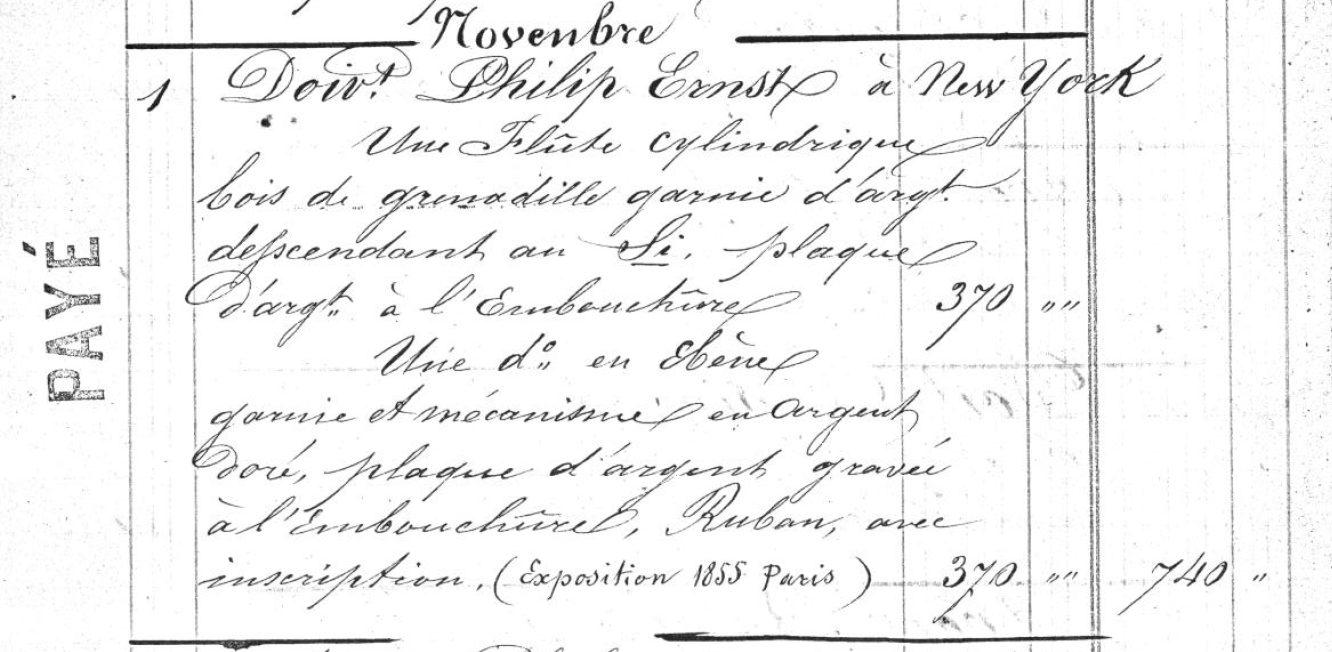
(Philip
Ernst’s order of two cylindrical wood flutes)
Continuing with the wood flutes sold to the United States, E. M. Fesser was the largest importer. Beginning in 1855, he bought 11 flutes over the course of three years, often ordering two or three at a time. Fesser was a student of Alrit. One of the purchases included 50 copies of L'Étude de la nouvelle flûte by Dorus for 187.50 FF.
|
Date |
s/n |
Name |
Description |
|
11/23/1855 |
- |
Fesser |
Cylindrical wood flute |
|
7/18/1856 |
- |
Fesser |
Cylindrical wood flute, silver lipplate |
|
7/18/1856 |
- |
Fesser |
Cylindrical wood flute |
|
10/17/1856 |
- |
Fesser |
Cylindrical wood flute, B-foot |
|
10/17/1856 |
- |
Fesser |
Cylindrical wood flute, B-foot |
|
7/8/1857 |
198 |
Fesser |
Cylindrical wood flute, B-foot |
|
7/8/1857 |
199 |
Fesser |
Cylindrical wood flute, B-foot |
|
8/17/1857 |
208 |
Fesser |
Cylindrical wood flute, B-foot |
|
8/17/1857 |
204 |
Fesser |
Cylindrical wood flute |
|
8/17/1857 |
203 |
Fesser |
Cylindrical wood flute |
|
6/9/1858 |
284 |
Fesser |
Cylindrical wood flute |
As noted in the section on silver flutes, Donjon’s first Louis Lot was a cylindrical wood flute. Breaking away from Tulou’s tradition, he bought this Boehm system wood flute right after receiving the first prize from the Paris Conservatory. Two years later, he bought his first silver Louis Lot, No. 339.
|
Date |
s/n |
Name |
Description |
|
12/17/1856 |
156 |
Donjon |
Cylindrical wood flute |
Other than Donjon, several flute players bought both silver and wood cylindrical flutes - different sound for different occasions. Émile Astruc and Jules Herman are two good examples. Even Baron Roger, who bought wood flute No. 1, acquired a silver flute later.
|
Date |
s/n |
Name |
Description |
|
11/29/1856 |
149 |
Astruc |
Cylindrical wood flute, B-foot |
|
11/4/1862 |
705 |
Herman |
Cylindrical wood flute |
|
1855-03-25 |
1 |
Roger |
Cylindrical wood flute |
Amédée de Vroye was another very important flutist who played a Louis Lot cylindrical wood flute. He was the solo flutist of the Théâtre-Lyrique in Paris. Saint-Saëns dedicated his Romance in D-flat major, Op. 37, to him. Along with Dorus, Boehm singled out de Vroye as having fine taste.
|
Date |
s/n |
Name |
Description |
|
4/2/1857 |
171 |
De Vroye |
Cylindrical wood flute |
M. Gérolt, flutist and composer in Nancy, was instrumental in promoting Louis Lot’s cylindrical wood flutes. He bought six, quite a commitment to a relatively new type of instrument, so his flute network must have been extensive.
|
Date |
s/n |
Name |
Description |
|
3/11/1859 |
352 |
Gérolt |
Cylindrical wood flute |
|
5/30/1859 |
- |
Gérolt |
Cylindrical wood flute |
|
6/4/1861 |
558 |
Gérolt |
Cylindrical wood flute |
|
1/15/1862 |
- |
Gérolt |
Cylindrical wood flute, maillechort keys |
|
5/18/1862 |
- |
Gérolt |
Cylindrical wood flute, old pitch |
|
1/10/1863 |
715 |
Gérolt |
Cylindrical wood flute, old pitch |
Manuel Huertas in Le Havre was also responsible for five cylindrical wood flute purchases from Louis Lot.
|
Date |
s/n |
Name |
Description |
|
8/31/1855 |
- |
Huertas |
Cylindrical wood flute |
|
1/31/1857 |
- |
Huertas |
Cylindrical wood flute |
|
6/30/1858 |
286 |
Huertas |
Cylindrical wood flute |
|
8/9/1858 |
- |
Huertas |
Cylindrical wood flute |
|
7/11/1863 |
754 |
Huertas |
Cylindrical wood flute, old pitch |
To close this section, it is worth highlighting the most expensive cylindrical wood flute recorded in Louis Lot’s production journal. It is the only cylindrical wood flute known to have been made with gold keys, making it an exceptional instrument within the early production. Prince Héraclius of Georgia purchased the flute for the remarkable sum of 1,800 FF.
|
Date |
s/n |
Name |
Description |
|
10/14/1861 |
- |
Heraclius |
Cylindrical wood flute, gold keys and trim |
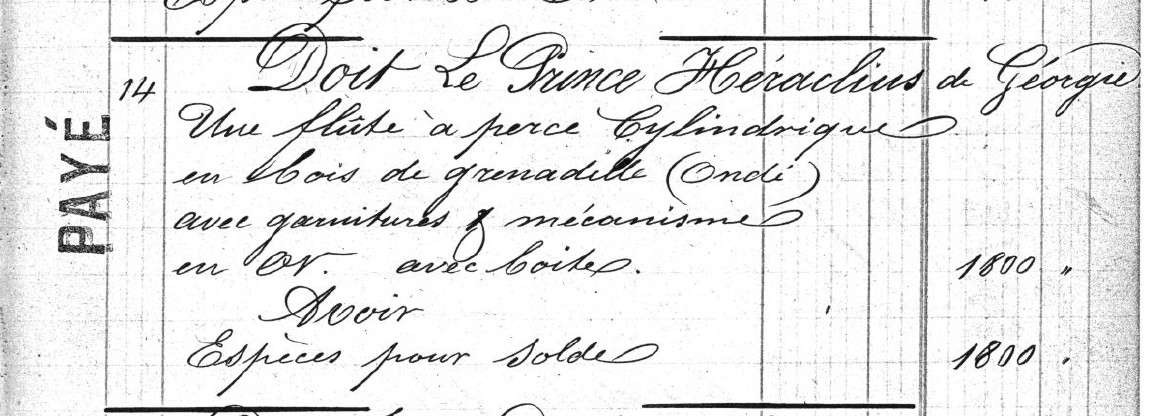
(Cylindrical
wood flute with gold keys)
by David Chu, 2026, Maynard, Massachusetts
-
Continue to
Section 9, Ring-Key Flutes
Copyright
© 2026 David Chu
For more information please email Alan Weiss at alan@vintagefluteshop.com