Vintage Flute Shop
Articles
“My Notes on the Accounting Records of Louis
Lot, 1855-1864”
9. RING-KEY FLUTES
It was then as it is now: a top of the line flute is a luxury item. In the mid-nineteenth century, 500 FF for a silver flute represented a substantial portion of a musician’s yearly pay. Musicians at the Paris Opéra earned between 1,500 FF and 3,500 FF per year, while full-time professors at the Paris Conservatory earned somewhat less, though still within a comparable range.
For a player considering a transition from the simple-system (ordinary) flute to the Boehm system, the decision therefore represented not only a significant financial investment but also a considerable commitment of time and effort. By comparison, the least expensive 5-key ordinary flute by Louis Lot cost only 70 francs, making the price of a 1847 system Boehm flute seven times that of a basic traditional instrument.
A middle ground would be the 1832 system ring-key conical wood flute. A flute with a D-foot and maillechort keys was only 150 FF - still twice as much as a 5-key ordinary flute. During Louis Lot’s first nine years in business, the firm sold 151 conical flutes, compared with 129 cylindrical wood flutes.
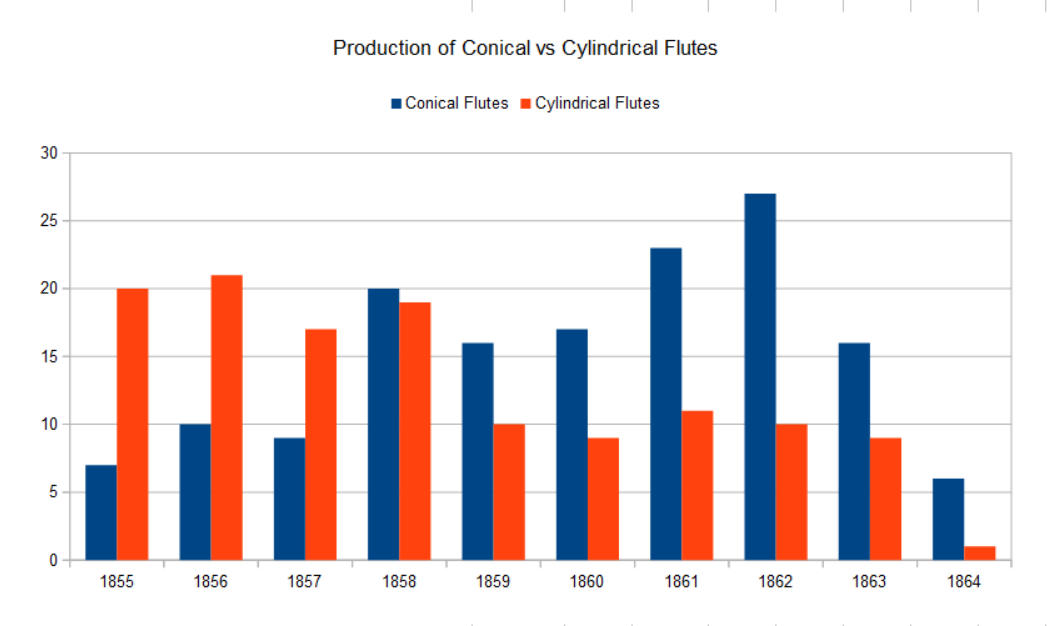
(Production
of conical vs cylindrical wood flutes by year)
The revenue of wood cylindrical flutes was quite a bit higher in spite of fewer flutes made.
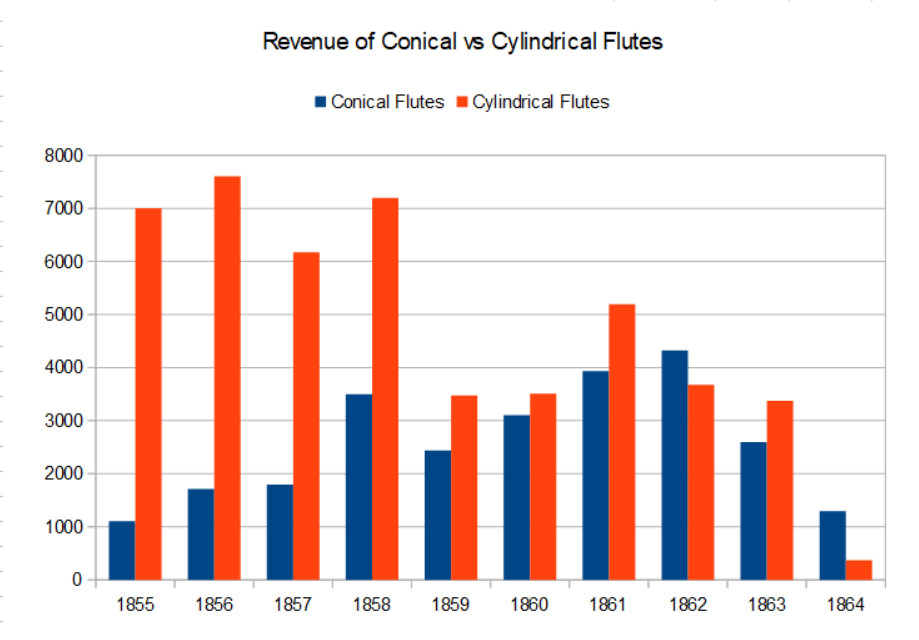
(Revenue
of conical vs cylindrical wood flutes by year)
There seems to be a decline in cylindrical wood flute production. This may have been due to the fact that the silver cylindrical flute was gaining momentum, as it was to become the official flute of the Paris Conservatory in 1860. The cylindrical wood flute was a direct competitor to its silver sibling. The choice of a silver flute was starting to win out. However, the conical flute was holding its ground a bit better. It was not in direct competition with the cylindrical metal or wood flute. It offered a different sound, one that would suit the French taste better, a result of Godfroy’s modifications from the Boehm design, including a different bore, embouchure and the new invention of the Dorus G#.
Godfroy and Buffet were already manufacturing the 1832 system Boehm conical flutes in France before Louis Lot struck out on his own. Lot had been working with Godfroy, and soon after married the boss’ daughter. Thus, Vincent Hypolite Godfroy became his brother-in-law, and later, business partner after Clair Godfroy, his father-in-law, died in 1836. The partnership lasted until Louis Lot started his own workshop in 1855.
The ring-key flute with a D-foot and maillechort mechanism was the least expensive model offered. Its catalog list price was 150 FF, although most examples actually sold for around 100–120 FF, depending on the discount. This would have been the most affordable way to learn to play a Boehm system flute. A total of 88 instruments of this model were sold, more than half the total production of ring-key flutes.
Flutes fitted with silver keys were only available with a C- or B-foot, a D-foot was not offered as an option for this configuration. This suggests that the silver-key model was intended for a more discerning and affluent clientele. Nevertheless, the most expensive ring-key flute sold during this period was a B-foot model with silver keys, which sold for 375 FF — approximately 17% below its 450 FF list price. Louis Lot only made three B-foot flutes, two with silver keys and one maillechort.
About half of the flutes were ordered with a Bb shake. The option cost 7 FF on a maillechort flute and 10.50 FF on a silver one. In practice, however, Louis Lot’s actual sale prices were flexible. For example, on flute No. 546, a maillechort flute, the Bb shake option was charged at 10 FF. Many records don’t itemize the Bb shake separately, giving only a total price instead. While the majority of the pricing structure falls within a fairly consistent general range, I have found no discernible metric that justifies the subtleties of these floating prices.
Louis Lot did not produce any cylindrical Db flutes, either in wood or metal. He did, however, make three ring-key flutes in Db, Nos. 460, 563, and 684. Even more unusual is an Eb flute, No. 425, made for Simon Lauret of Marseille, which Louis Lot described as une flûte tierce en fa.
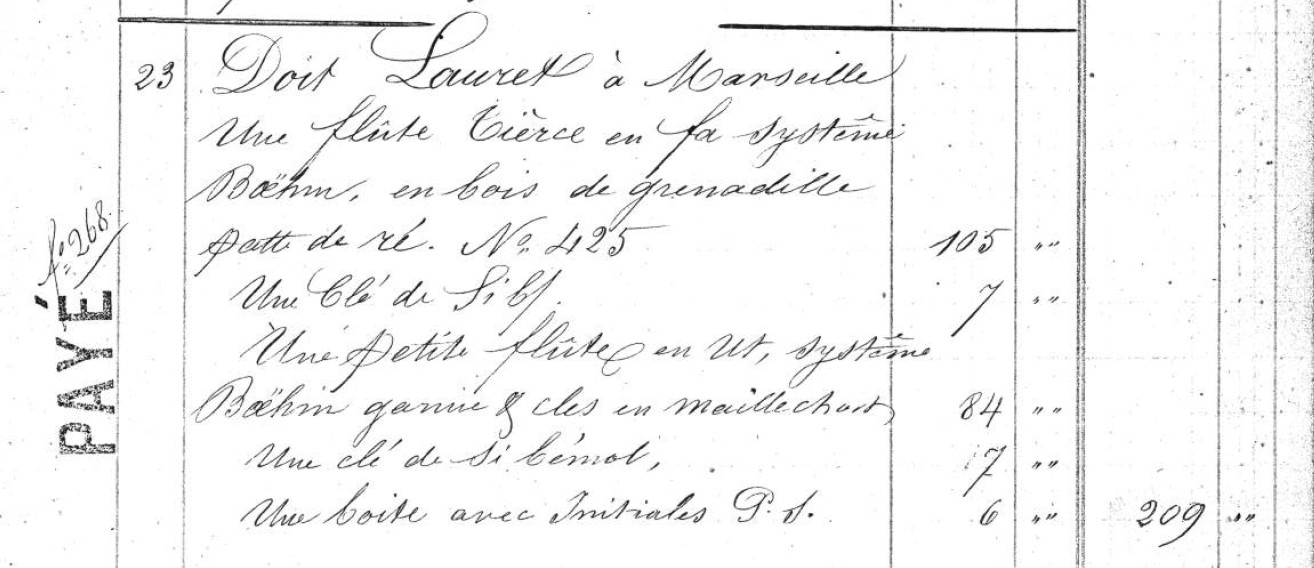
(Third
flute No. 425)
The term “flûte tierce” means third flute, specifically a minor third higher. In relation to the modern silver flute, whose lowest note is C, a third flute would be one in Eb. However, with traditional flutes featuring six finger holes that descend to D, a third flute would play an F when all the finger holes are close — hence une flûte tierce en Fa.
This confusion even warrants a passage in Berlioz’s Grand Traité d’instrumentation et d’orchestration modernes: “The third flute (called in F) whose C plays Eb, and which must, in accordance with what we stated at the beginning of this chapter, be classified among the transposing instruments in Eb.”
Customers
of Louis Lot’s Ring-Key Flutes
Among Louis Lot’s most prolific customers was Jean-François Nauwelaers, flutist in the Lyon Théâtre Orchestra, who purchased 30 ring-key flutes. He was followed by Simon Lauret, associated with the Marseille Conservatory, who purchased 17 flutes, including one on behalf of Philippe Gattermann, author of Méthode pour la nouvelle flûte de Boehm, published in Paris around 1861. Gattermann was born in Belgium and was active in Paris as a flutist and composer.
Belgium was also an important market for Louis Lot’s ring-key flutes. Jean Dumon, professor of flute at the Royal Conservatory of Brussels, purchased eight flutes. Another Belgian musician, Auguste Mermet, the composer of the opera Roland à Roncevaux, also purchased a ring-key flute, No. 558.
In southern France, Joseph-Jean Fournez, a professional flutist in Toulouse, was credited with the purchase of nine flutes, including No. 718, the only ring-key flute with silver-plated maillechort keys.
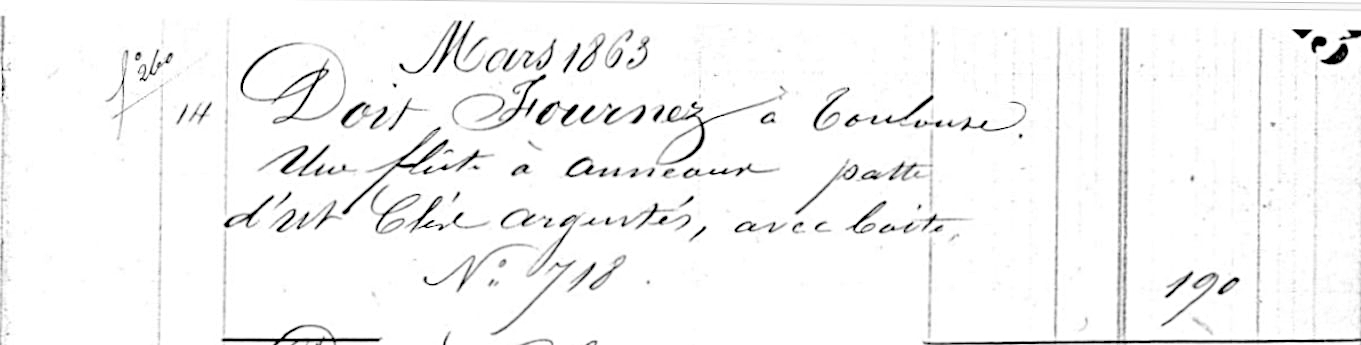
(No.
718, silver-plated ring-key flute)
Émile Astruc, principal flutist of the Grand Théâtre de Marseille, purchased four flutes, although he appears to have been primarily a silver-flute player.
Among Parisian players, Victor-Henri Leplanquais, flutist at the Opéra-Comique, purchased No. 261, for which he paid an extra 10 FF for a Moroccan leather case.
Johannes Donjon, who also played silver flute, purchased two ring-key flutes on behalf of the Fathers’ College, a Catholic secondary school.
Adolphe Sax, the inventor of the saxophone, also bought three ring-key flutes, two ordinary 5-key flutes, and several Db piccolos when he was seeking his fortune in Paris. He obtained his French patent for the saxophone in 1846. Theobald Boehm, Louis Lot, and Adolphe Sax were successful pioneers of their era, but they operated on very different scales. Sax ran factory-sized enterprises, whereas Boehm and Louis Lot maintained relatively small workshops. The three flutes purchased by Sax may have been acquired for his personal use, for study and experimentation, or for resale.
|
Date |
s/n |
Name |
Description |
|
4/7/1859 |
- |
A. Sax |
Ring-key flute, maillechort keys, C foot |
|
11/8/1861 |
593 |
A. Sax |
Ring-key flute, maillechort keys, C foot |
|
11/8/1862 |
- |
A. Sax |
Ring-key flute, maillechort keys, C foot |
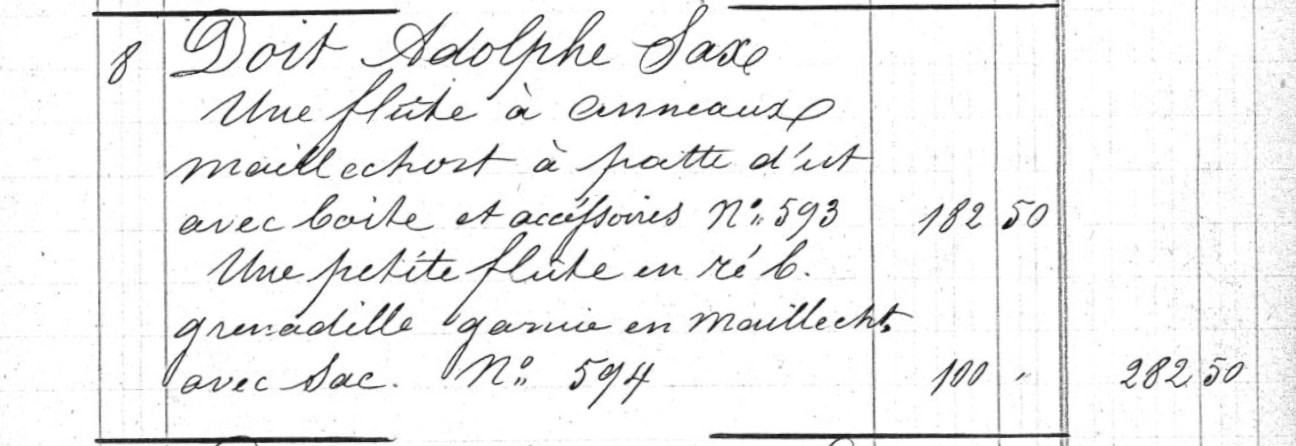
(Adolphe
Sax’s order of a ring-key flute and a piccolo)
These purchases demonstrate that Louis Lot’s ring-key flute was not confined to a single school, city, or type of player. Its customers included prominent orchestral and conservatory flutists in Paris, Lyon, Marseille, Toulouse, and Brussels, as well as players who otherwise favored silver instruments. The journal therefore provides an illuminating picture of the circulation and adoption of Louis Lot’s instruments among professional European flutists during the mid-nineteenth century.
by David Chu, 2026, Maynard, Massachusetts
-
Continue to
Section 10, Other Makers and Innovators
Copyright
© 2026 David Chu
For more information please email Alan Weiss at alan@vintagefluteshop.com