Vintage Flute Shop
Articles
“My Notes on the Accounting Records of Louis
Lot, 1855-1864”
10. OTHER FLUTE MAKERS
AND INNOVATORS
Louis Lot sold many flutes, parts, and supplies to his fellow flute makers. The most famous, of course, was Theobald Boehm from Munich, the inventor of the flute himself!
Boehm bought many cases, cleaning swabs, screws, grease pots, end caps, locks with single and double pins, and pad-making supplies. His major purchase was 20 incomplete wood flute bodies from Louis Lot, all without keys. In flute-making companies today, body-making is generally considered a lower-ranking position than stringing (key-making) and padding (finishing work). Yet the body contains the essential acoustic properties of the instrument: the bore, tone holes, and joints. However rudimentary body-making may appear, it is therefore misleading to dismiss it as a less skilled labor or art form.
This is particularly evident in the construction of modern silver flutes with soldered tone holes. Excessive heating during the tone hole soldering process can change the temper of the silver, softening the tube and potentially compromising its acoustics properties. Such work requires considerable skill and control of the flame. It is certainly not a task that could simply be relegated to a lower-paid worker.
Boehm, however, held Louis Lot’s workmanship in high esteem. His decision to purchase unfinished wood bodies from Louis Lot may therefore have reflected not only his respect for Lot’s craftsmanship but also a practical desire to save time. Cross-referencing Boehm’s production records with those of Louis Lot may help identify which Boehm flutes were fitted with French-made bodies.
In addition, Boehm purchased a ring-key piccolo in 1857 and an 8-key ordinary flute the following year, paying full price for both instruments. In the nine years of doing business with Boehm, Louis Lot recorded a total transaction amount of about 1,750 FF in the journal. By comparison, the sum Boehm charged Louis Lot and Godfroy for the exclusive rights to manufacture his 1847 system flute was 6,000 FF. Assuming that Godfroy and Louis Lot each paid half of this amount, Louis Lot would have recovered more than half of his investment simply through the sale of flutes and parts to Boehm.
Another equally famous (if not more famous) instrument maker who maintained an account with Louis Lot was Adolphe Sax. Originally from Belgium, Sax came to Paris to pursue his dream of building a new musical instrument that would become the voice of the future and bridge the tonal gaps between the woodwind and brass families.
Between 1856 and 1862, Sax purchased eight Db piccolos, two fifes, three ring-key flutes, and two 5-key flutes from Louis Lot, for a total sale price of 1,307 FF. However, the account records show that Sax was credited with a total amount of 2,118 FF. This discrepancy suggests that there are likely additional invoices or transactions that have yet to be located.
Famous for its clarinets, Buffet Crampon & Cie was established following a reorganization in 1859 led by Buffet-Crampon, Leroy & Goumas. In 1860, Louis Lot had three transactions with the firm. Buffet-Crampon purchased a cylindrical wood flute, a Db piccolo, and two cleaning rods fitted with built-in screwdrivers. The purpose of these purchases is unclear. They may have been acquired for resale, to fulfill customer orders, or for other commercial purposes. Goumas took over the company in 1865 and, at some point thereafter, began producing some exceptionally fine cylindrical wood and metal flutes.
|
Date |
s/n |
Name |
Description |
|
5/29/1860 |
465 |
Buffet Leroy & Goumas |
Cylindrical wood flute, all joints lined in maillechort |
|
9/15/1860 |
- |
Buffet Crampon & Cie |
Db piccolo |
|
10/13/1860 |
- |
Buffet Crampon & Cie |
2 cleaning rods with built-in screwdrivers |
Rudall Rose Carte & Co. held the exclusive license to manufacture the 1847 system Boehm cylindrical flute in England. The firm placed a series of substantial orders with Louis Lot. Between 1855 and 1861, these orders totaled 3,024 FF and included both instruments and supplies: 16 oboes (with 10 to 16 keys), 21 5-key piccolos, and an 8-key third flutes in Eb. The final order was placed on July 18, 1861, with no further orders recorded before the journal concludes in 1864.
Not surprisingly, there were no orders for Boehm flutes of either the 1832 or 1847 system during this period since these instruments were the specialties of the English firm. Around 1855, Rudall Rose Carte & Co. also took over Key & Co., an established instrument maker with a significant presence in the military instrument trade. The French-made oboes and piccolos ordered from Louis Lot appear to have been intended, at least in part, to fulfill the firm’s military instrument orders.
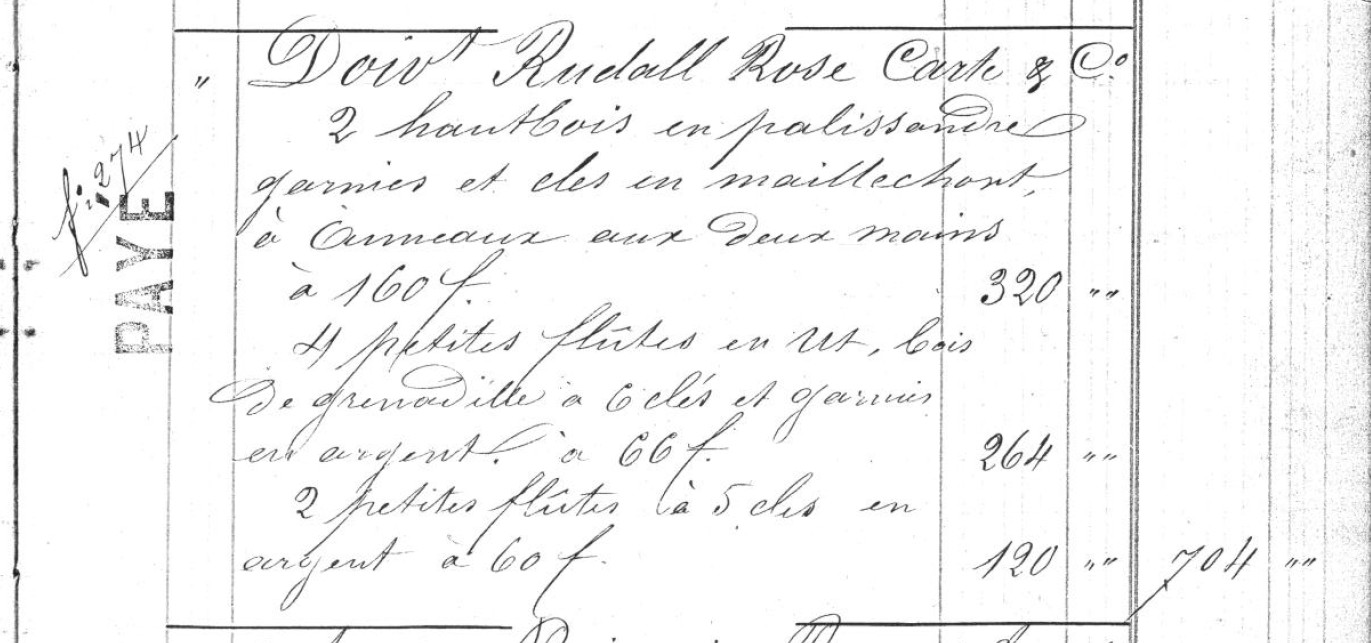
(Example
of a Rudall Rose Carte & Co. order)
Another English flute innovator, Richard Shepherd Rockstro, bought a single piccolo, No. 751, from Louis Lot, fitted with several additional keys. It was an open G# instrument, a configuration rarely encountered in the journal, I only found four examples. In addition to his innovative modifications to flute keywork, Rockstro advocated for large tone holes, intended to increase projection and power, following a principle popularized by virtuosos such as Charles Nicholson.
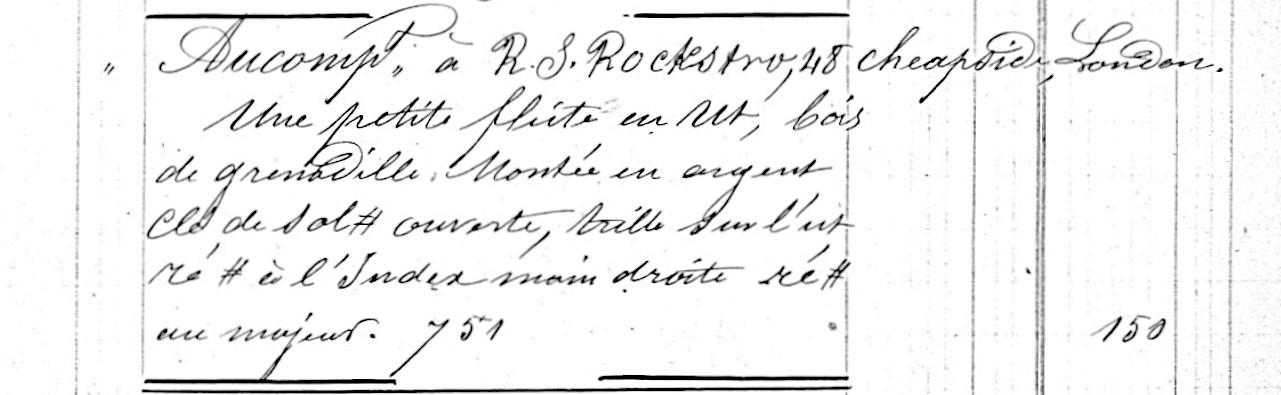
(No.
751, open G# piccolo for R.S. Rockstro)
Walter Broadwood, better known for his association with piano making than flute making, also ordered an open G# silver flute and a headjoint from Louis Lot. He was a close confidant of Boehm and a regular customer, and later translated Boehm’s An Essay on the Construction of Flutes into English.
The flute Broadwood ordered is now in the author’s collection, No. 636. Although its serial number was not recorded in the journal, it is the only instrument that matches the description within the appropriate period and is therefore almost certainly the flute in question. It is also the only Louis Lot flute made with a reverse thumb Bb.
The headjoint that Broadwood ordered is also quite unique, a silver headjoint with a wood lipplate and a gold riser. This configuration has once again become popular in recent years, with several contemporary makers, including the author, now producing headjoints in this combination.
|
Date |
s/n |
Name |
Description |
|
10/20/1857 |
- |
Broadwood |
Silver flute headjoint, an ebony embouchure, ringed in gold |
|
8/8/1862 |
636 |
Broadwood |
Silver flute, open G# key, guillochée lipplate, reversed thumb |
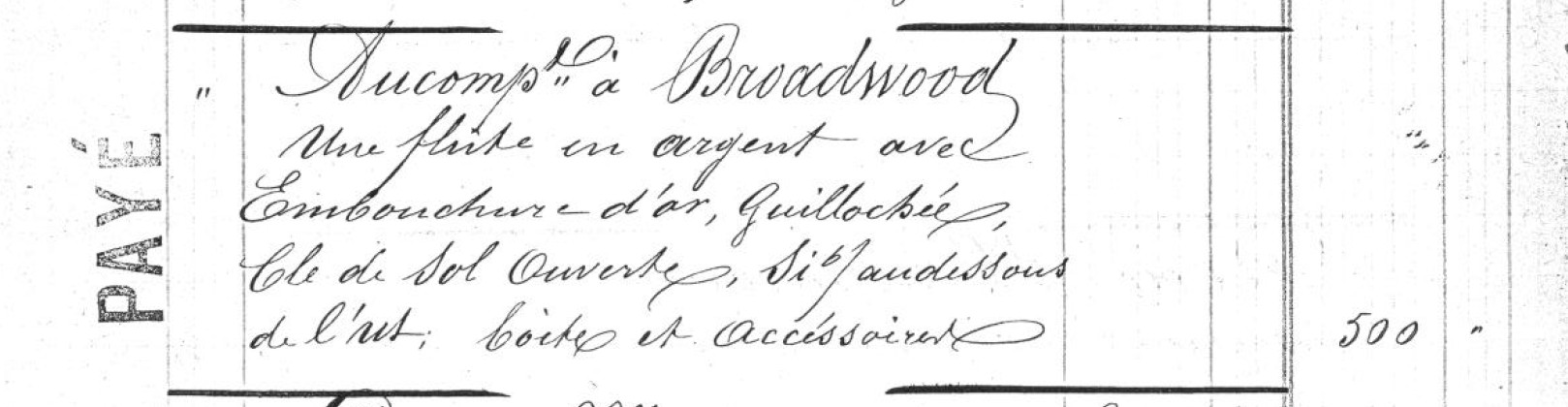
(Broadwood’s
No. 636 with open G#)
Two of the simplest innovations in flute design would have to be the Brossa F# and the gizmo. In both cases, the fundamental mechanism remains unchanged. A simple additional tab is all that is required to introduce a new means of operating a key cup and achieve the desired effect.
The inventor of the Brossa F#, Jean Firmin Brossa, won the first prize at the Paris Conservatory in 1865. He returned to England to play in the Hallé Orchestra in Manchester. He bought his Louis Lot while studying with Dorus.
|
Date |
s/n |
Name |
Description |
|
6/12/1863 |
740 |
Brossa |
Silver flute |
Mechanically speaking, the thumb-key arrangement is arguably the weakest aspect of the entire Boehm key system. The combination of a relatively short axle and exceptionally long levers creates excessive torque within the mechanism. The result is a set of thumb keys that are inherently prone to wobble and instability. This design would evolve into what we now commonly call the Briccialdi Bb.
Giulio Briccialdi, the Italian flute virtuoso, bought two Louis Lot metal flutes, which were already listed in Section 6, Maillechort.
A few flute makers have refined their manufacturing techniques enough to produce a more stable thumb Bb mechanism, while others continue to struggle with the inherent mechanical limitations of the design. Various solutions—including the double axle, sleeve axle, and angled axle—have been attempted, but none has truly eliminated the fundamental problem.
Founded by François Millereau in Paris in 1861, the Millereau firm began as a maker of brass instruments. It started making Boehm cylindrical flutes in 1873, even though Louis Lot’s exclusive license to produce them in France had already expired 10 years prior. Being a brass instrument maker, the firm was better positioned to take advantage of the expiration of Adolphe Sax’s patent in 1866 and began making saxophones almost immediately. In the Louis Lot journals, a piccolo is recorded as being sold to Millereau in 1864.
|
Date |
s/n |
Name |
Description |
|
3/18/1864 |
811 |
Millereau |
Boehm system piccolo |
Millereau’s
flutes made after 1879 were heavily influenced by the keywork design of Villette.
Isidor Lot, Louis Lot’s nephew, operated independently as a woodwind maker in La Couture-Boussey, the historic heartland and industrial backbone of French woodwind manufacturing. His output included flutes, clarinets, flageolets, and oboes.
Based on Louis Lot’s workshop journals, Louis Lot acted as a financial benefactor for his nephew, regularly subsidizing and settling his professional and personal expenses. The accounts cover workshop supplies such as cases, tuning forks, silver wire, and parts from makers like Buffet Crampon, alongside major cash advances and loans sent by postal delivery. In 1860, there was even an entry of a flute body without keys, not unlike the way Louis Lot supplied the same to Boehm.
Beyond trade transactions, the ledgers record an eclectic mix of Isidor’s personal outlays covered by his uncle. These ranged from newspaper subscriptions and church ornaments to medical comforts, rifle repairs, and travel inquiries, painting a picture of an uncle deeply entwined in managing both the trade and personal solvency of his relative.
by David Chu, 2026, Maynard, Massachusetts
-
Continue to
Section 11, Fun Facts
Copyright
© 2026 David Chu
For more information please email Alan Weiss at alan@vintagefluteshop.com