Vintage Flute Shop
Articles
“My Notes on the Accounting Records of Louis
Lot, 1855-1864”
11. FUN FACTS
I think the real gems in the journal are the occasional tidbits tucked into this section. Going through the journal is a bit like walking along the beach, looking for bits of seashell or sea glass. Every now and then, I come across an oddly shaped pebble that catches my eye and I bring it home with me. These little discoveries are presented here in no particular order.
* * *
The first and third silver flutes Louis Lot sold were gold-plated - they went to Scudamore and Giovanni de Balabio of Milan, respectively. Scudamore’s flutes and connection to Dorus were introduced in Section 5, Players of Silver Flutes 1. Balabio was a prominent nineteenth-century Italian flute patron and amateur. He is best remembered today for being the dedicatee of Briccialdi’s Lucrezia e Lucia, Op. 46. A year after he received his gold-plated flute, he ordered a second flute with an A-foot for 500 FF. Four years later, he sent the same flute for an overhaul and paid 40 FF for the work - much more than the usual overhaul fee of between 20 – 30 FF. The record described the instrument as his “flute en la.” Could this flute be a special flute d’amour or just one with a long foot?
|
Date |
s/n |
Name |
Description |
|
10/10/1855 |
- |
G. de Balabio |
Silver flute, gold plated tubes and keys |
|
7/19/1856 |
- |
G. de Balabio |
Silver flute, descend to A |
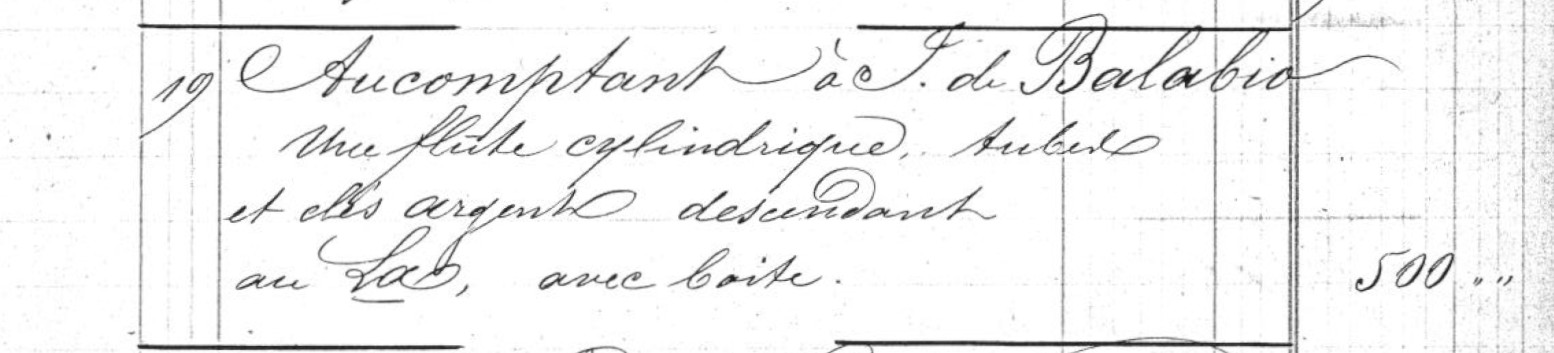
(Balabio’s
A flute)
* * *
The second silver flute went to N. A. Destrehan (Nicolas Azby Destrehan), a member of a prominent Creole Louisiana family. In 1855, he embarked on a two-year grand tour of Europe. The family archive may contain the receipt documenting his purchase of this flute. He came back to Paris in 1861 and got married. However, he died of smallpox the next year at the age of 28.
Edgar Degas and N. A. Destrehan were born just one year apart. Degas knew Altès and painted his portrait in 1868.
Degas’s mother, Célestine Musson, came from an elite New Orleans Creole family. Her mother, Marie-Céleste Désirée Rillieux, belonged to the prominent Rillieux family. The Historic New Orleans Collection’s property records show that Rillieux and Destrehan properties were directly adjacent on Chartres Street. In 1825, the Destrehan family acquired part of a property that had belonged to the succession of the widow of Vincent Rillieux, Degas’s great-grandfather.
Given their shared New Orleans social milieu, their overlapping family connections, and the fact that both later spent time in Paris, it is possible that Degas and Destrehan crossed paths.
* * *
Louis Lot offered wood flutes in either “Grenadilla or Ebène.” I have a strong feeling that the Ebène referred to here was not true ebony, but rather cocuswood (Brya ebenus). Interestingly, in the catalog, Ebène was not offered as an option for the highest-priced cylindrical wood flutes with silver keys. All of the other wood flute models, however, offered a choice of either Grenadilla or Ebène.
However, the journal shows that two cylindrical wood Ebène (du Portugal) flutes with silver keys were produced. The exact distinction between Ebène and Ebène du Portugal remains a mystery. Louis Lot also used the term “grenadille ondé” (figured grenadilla) for six cylindrical flutes and one ring-key wood flute, including the gold-keyed instrument for Prince Héraclius of Georgia mentioned in Section 8, Cylindrical Wood Flutes. Two others featured engraved lipplates, and one had engraved rings. It must have been a special wood to warrant the extra attention and expense.
* * *
Ivory is not a material that one would normally associate with Louis Lot. Godfroy made many simple-system flutes with ivory rings. In July 1859, Louis Lot produced a single ivory headjoint for J. B. Cricorzo of Constantinople. Three months earlier, Cricorzo had ordered a cylindrical wood flute with a lined headjoint, a chased silver cap, and an engraved plaque bearing his name, “Cricorzo”. It is very likely that the headjoint was intended for this instrument. The headjoint was priced at 70 FF, compared with approximately 20–25 FF for a wood headjoint.
|
Date |
s/n |
Name |
Description |
|
4/13/1859 |
- |
J. B. Cricorzo |
Cylindrical wood flute |
|
7/8/1859 |
- |
J. B. Cricorzo |
Ivory headjoint |
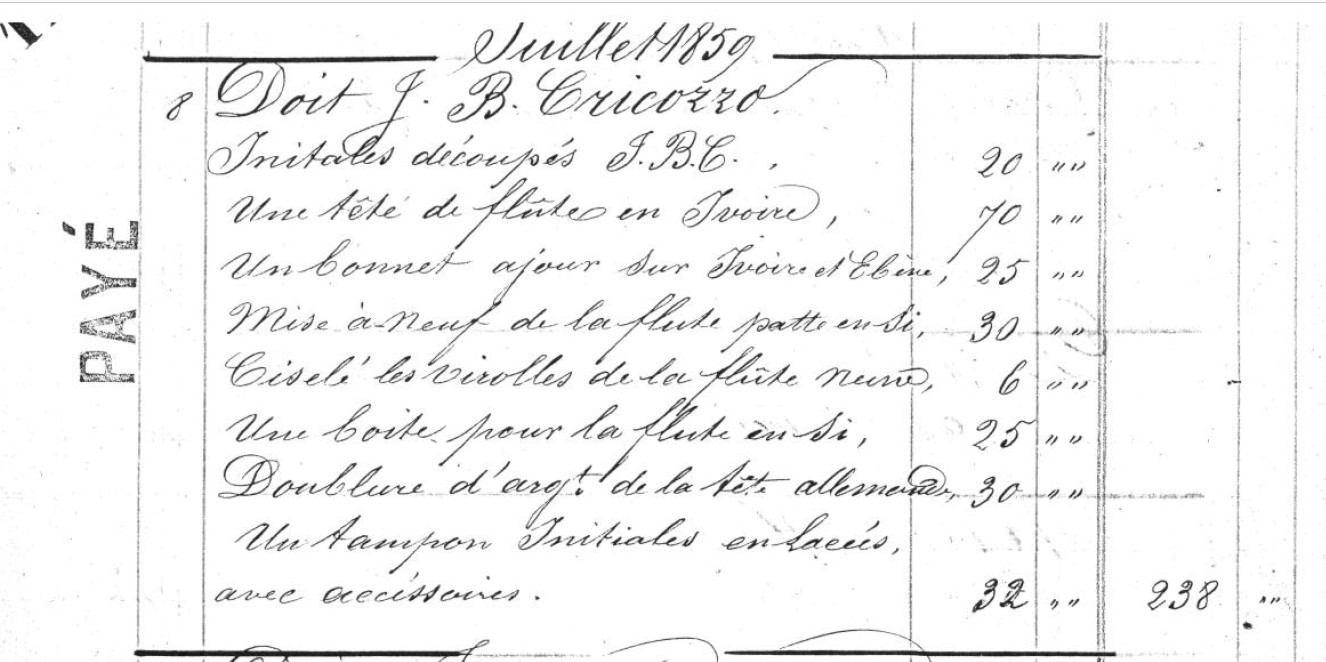
(Cricorzo’s
order of an ivory headjoint, etc.)
* * *
A gold embouchure was a very popular option on a silver flute. Fifty-nine out of 200 flutes were sold with one. The extra cost was 60 FF or, sometimes, 80 FF. Louis Lot’s flexible pricing makes it difficult to pin down a consistent surcharge.
Guillochée (engine-turned) lipplates became popular as soon as they were introduced in June 1862. Over the following 21 months, through the end of the journal, a total of 13 flutes were sold with this option, three of them were finished in gold lipplates.
* * *
Only a single flute with a one-piece body was found in the entire journal. It was made for Graham Browne, a student of the Italian flutist and composer Cesare Ciardi. Ciardi dedicated his Divertimento on “Ernani” to Browne.
|
Date |
s/n |
Name |
Description |
|
2/4/1861 |
- |
G. Browne |
Silver flute, without foot, with a long Moroccan case to hold the flute fully assembled. |
* * *
In England, beginning around the end of the nineteenth century, when high-pitch instruments had become obsolete, Rudall Carte would transfer the keywork from a high-pitch flute onto a new low-pitch body. I was surprised to discover that Louis Lot had been doing the same as early as 1860, in this case for Charles Herval. The cost was 75 FF. The circumstances behind the work are unknown. It may have been done for reasons of cost, because the original body had been damaged, or perhaps for sentimental reasons. Herval was a good customer of Louis Lot and purchased many flutes from the company over the years. It would not have been unreasonable for Louis Lot to take on the occasional custom job.
|
Date |
s/n |
Name |
Description |
|
3/20/1860 |
- |
Charles Herval |
Making a cylindrical wood flute, transferring the mechanism to new wood. |
* * *
Needle springs made of blue steel were used on all Louis Lot flutes, but gold springs were also available.
|
Date |
s/n |
Name |
Description |
|
1/7/1863 |
- |
Arrigunaga |
Overhaul, new pads and gold springs |
* * *
The large tone-hole dimensions used in footjoints today were developed around 1863, towards the end of the journal. The first entry describing this feature appears in July of that year.
|
Date |
s/n |
Name |
Description |
|
7/10/1863 |
753 |
Oluf Svendsen |
Silver flute, gold embouchure, large tone holes on the foot. |
In March 1864, Graham Browne, the London flutist who had previously purchased a one-piece Louis Lot flute, ordered a separate footjoint with large tone holes. He must have had another flute to use with the new footjoint.
* * *
In 1860, Louis Lot’s best year thus far, I found in the journal that he sold 37 silver or maillechort flutes to 27 different customers. The Conservatory alone bought 5 flutes. And there were several other individuals who bought more than one silver flute that year.
* * *
Honoré Désiré Villette had to wait 22 years before taking the reins of the Louis Lot company, a position he would hold for another seven years. During this period, he was finally able to realize his vision of a newly designed flute that was entirely his own.
Louis Lot’s journal records two substantial payments to Villette, 1,209 FF in 1861 and 1,057.10 FF in 1862. Both payments correspond closely to 5% of the workshop’s revenue for the preceding year. This suggests that these payments were calculated on the basis of annual revenue rather than profit.


(Two
payments to Villette)
* * *
The journal is filled with the names of celebrated flutists. One page, for example, lists Boehm, Dorus, Altes, and Leplus.
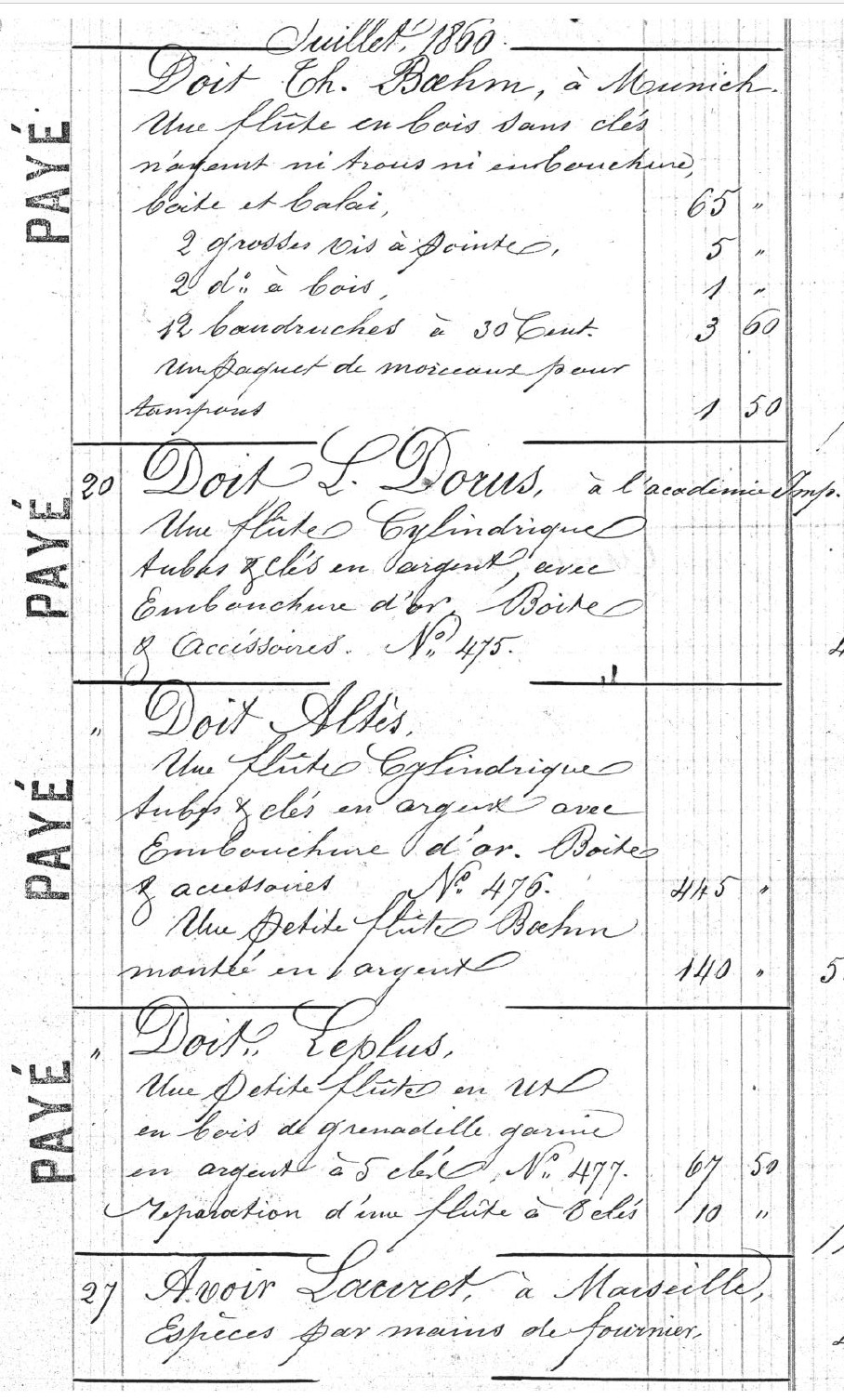
(A
page from July 1860 with names of Boehm, Dorus, Altes, and Leplus)
* * *
Being a case maker myself, I paid particular attention to the cases offered by Louis Lot. The journal shows that cases were sometimes included in the price of the flute and, at other times, listed as separate charges. It mentions a surprising variety of options: small cases, combination cases, cases for two flutes, mahogany and rosewood cases, Moroccan leather cases. Piccolos were often housed in pouches.
Among the more distinctive entries is a case fitted with an engraved silver lock plate and keyhole escutcheon, and many had silver plaques engraved with the owner’s initials. These details suggest that Louis Lot offered cases in a range of materials, styles, and levels of ornamentation, allowing the case to be tailored to the instrument and the customer’s preferences.
* * *
by David Chu, 2026, Maynard, Massachusetts
-
Continue to
Section 12, Dayton C. Miller’s Louis Lot Flutes
Copyright
© 2026 David Chu
For more information please email Alan Weiss at alan@vintagefluteshop.com