Vintage Flute Shop
Articles
“My Notes on the Accounting Records of Louis
Lot, 1855-1864”
12. DAYTON C. MILLER’S
LOUIS LOT FLUTES
The Dayton C. Miller Flute Collection, housed at the Library of Congress, is one of the world’s most extensive collections of flutes and related materials. Miller translated Theobald Boehm’s book The Flute and Flute-Playing into English for its first publication in 1922. I made my first bamboo headjoint by using the dimensions given in the book.
By the time Miller was collecting flutes in the late nineteenth century, the Louis Lot workshop had already passed through three owners and into the fourth, E. Barat. Of the nine Louis Lot instruments in the collection, only three fit into the time period covered by the first Louis Lot journal: Nos. 208, 162, and 261.
***
Dayton C. Miller - Flute in C, DCM 0091
Louis Lot Cylindrical Wood Flute, No. 208
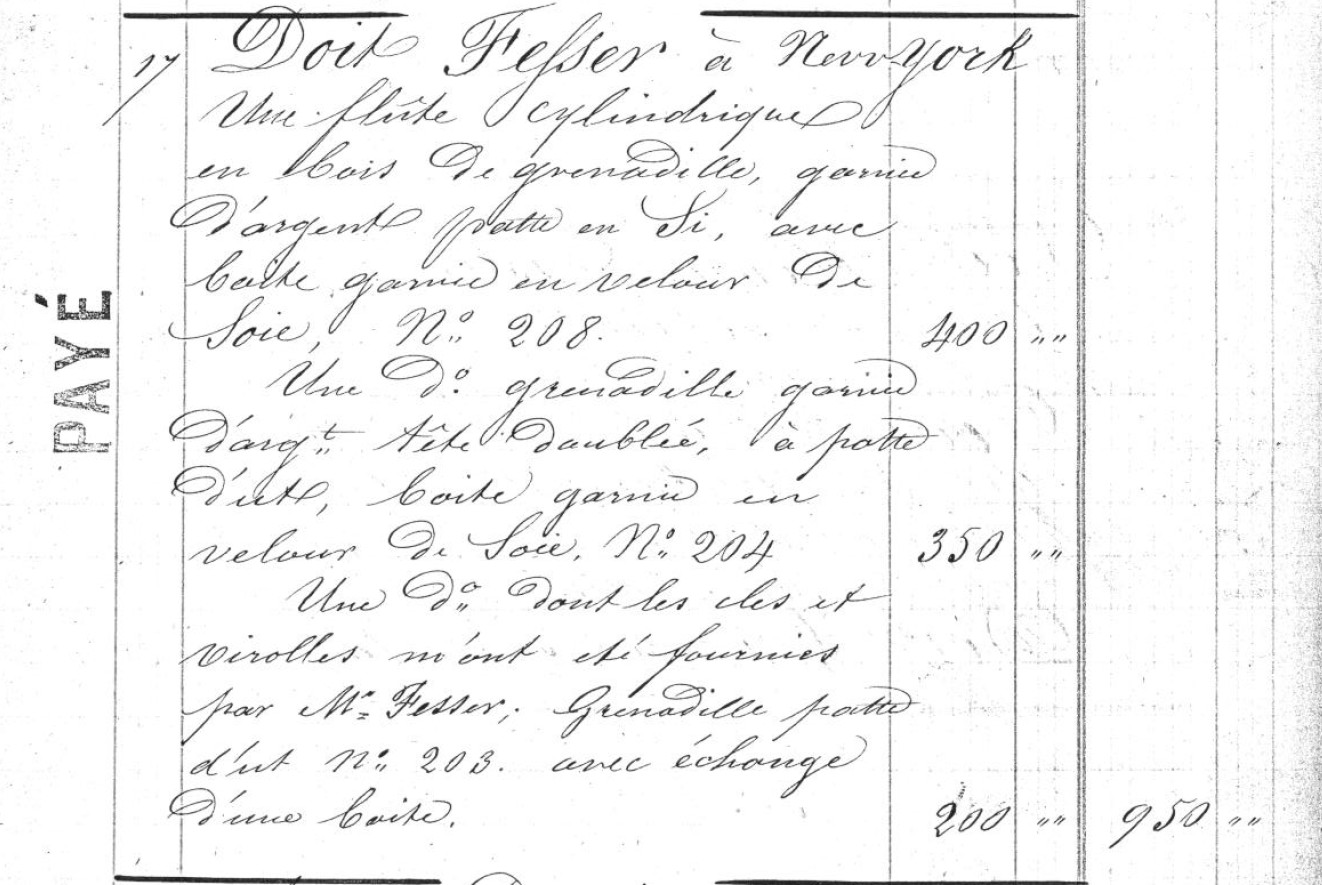
(Entry
for Louis Lot No. 208)
This is an excellent example of the type of flute Louis Lot was making in 1857: small key cups extending all the way to the footjoint, a Dorus G# key, a one-piece rib, and high pitch. The B-foot on this flute was quite unusual, as only 17 were made for cylindrical wood flutes before the journal concluded in 1864. Miller’s flute was one of 12 wood flutes that E. M. Fesser, an American importer, purchased from Louis Lot between 1855 and 1858. The complete list of the 12 flutes can be found in Section 5, Wood Cylindrical Flutes.
The journal record identifies this flute as being made of grenadilla, but Miller’s flute is clearly a cocuswood flute. Many of the early Louis Lot wood flutes I have examined are also made of cocuswood. There seem to be quite a few more cocuswood flutes in existence than what was recorded in the journal. This raises the possibility of a terminology or translation issue in Louis Lot’s records, or perhaps some inconsistency in the way the materials were documented.
There are a few details that were distinctive about this flute compared with Louis Lot’s later work: the word “Breveté” is stamped between the little C key cup and finger button rather than under the serial number, both trill pins were drilled into the tubing instead of the peak of the pointed arm, and the rounded ribs are similar to those of Godfroy. Later Louis Lot flutes have pointed ribs, similar to those found on modern flutes.
DCM 0091 was sourced by George Haynes, who had repeatedly located and curated instruments for Miller, including flutes and piccolos by Boehm & Mendler, Louis Lot, Badger, Rudall Carte, and Martin. Miller also collected flutes that were made by George Haynes including his famous low F alto flute.
***
Dayton C. Miller - Flute in C, DCM 0219
Louis Lot Silver Flute, No. 163
Miller acquired this flute in 1922 from the flute maker Christensen & Co. The serial number was not recorded in the journal. However, Miller was quick to notice that it was originally an open G# flute because the current independent G# on the flute had not been invented yet. Louis Lot made very few open G# flutes, and the one that matches the description and timeline is a flute that was sold to Trist in New Orleans. Miller’s No. 163 was the first open G# flute Louis Lot made.
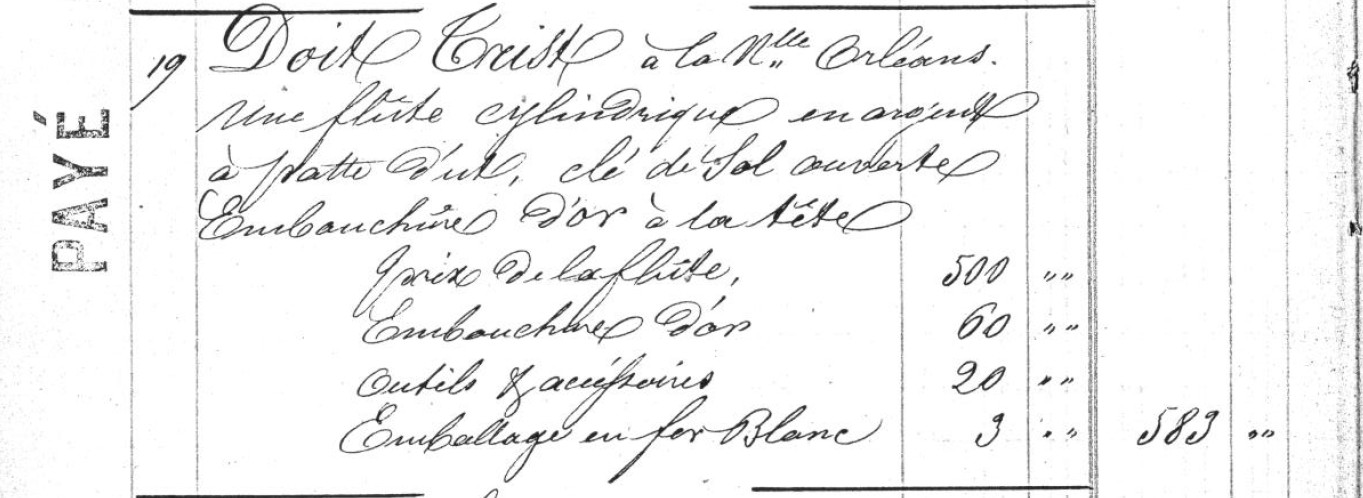
(Flute
sold to Trist in New Orleans)
Notice that the logo is engraved on the barrel and there is no Bb shake, which could have been deleted during the open G# conversion process. Unfortunately, the open hole cups have been mutilated. The gold lipplate also looks crooked, possibly as a result of a later repair. As is the case with many museum musical instruments, this flute remains mute and can only serve as a non-functional historical object.
Early flutes in private collections have often been restored to varying degrees of playable condition. It is a true privilege to have the opportunity to experience one of these remarkable instruments up close and in person. The intimacy of these flutes is immediately apparent. They feel remarkably light, sometimes weighing as little as 340 grams. Their smaller, shallower key cups and lower key height create a compact instrument. The shorter high-pitch body also enables a narrower finger spread. Yet the sound is surprisingly strong and projects well. The light, refined articulation is uniquely French.
***
Dayton C. Miller - Flute in C, DCM 0988
Louis Lot Ordinary 5-key Flute, No. 261
In the journal, No. 261 was assigned to a 1832 system ring-key flute rather than a 5-key flute.
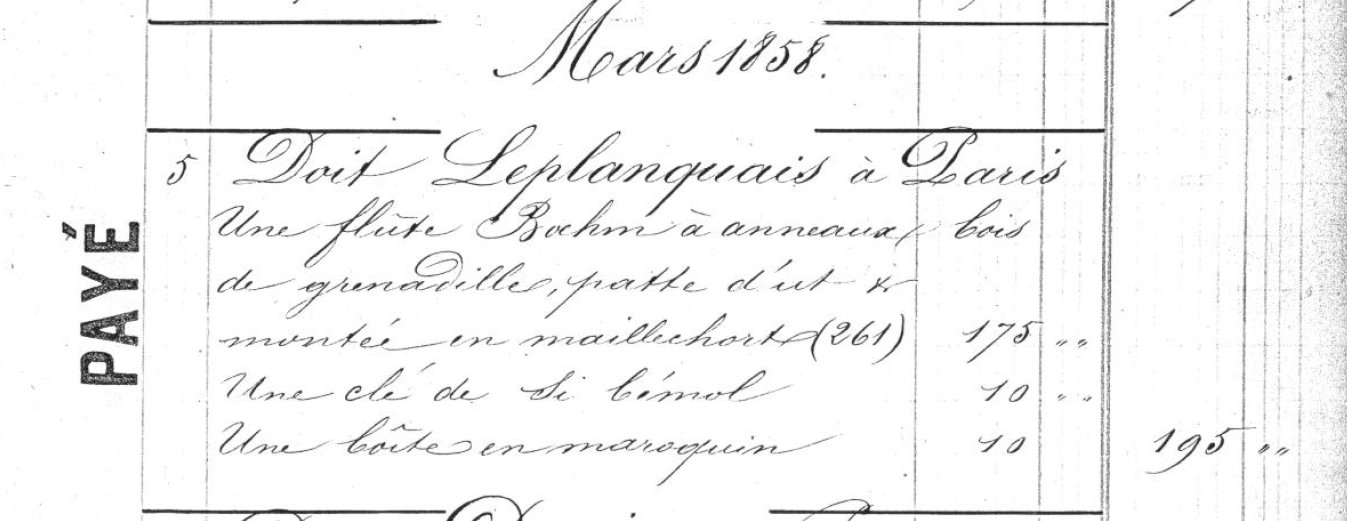
(Ring-key
flute No. 261)
As mentioned in Section 3, Serial Numbers, the journal contains numerous duplicate serial numbers. Finding Miller’s flute listing in the records may not be straightforward.
The clue may lie in the silver keys. There was no ordinary 5-key flute with silver keys made in 1858. No. 261 corresponds to approximately March of that year. The missing pages of the journal cover October 1858. Therefore, No. 261 could not be among the instruments recorded on the missing pages. However, there is an order “to make an ordinary flute in Portuguese ebony, using the rings and keys from an old flute” for 100 FF. The entry does not specify the material or the number of keys. The price of 100 FF is more than the price of a brand new 5-key maillechort flute and about half of one with silver keys - a cost structure that makes sense only if the customer-supplied keys and rings were made of silver. This may be a match for the Miller flute.
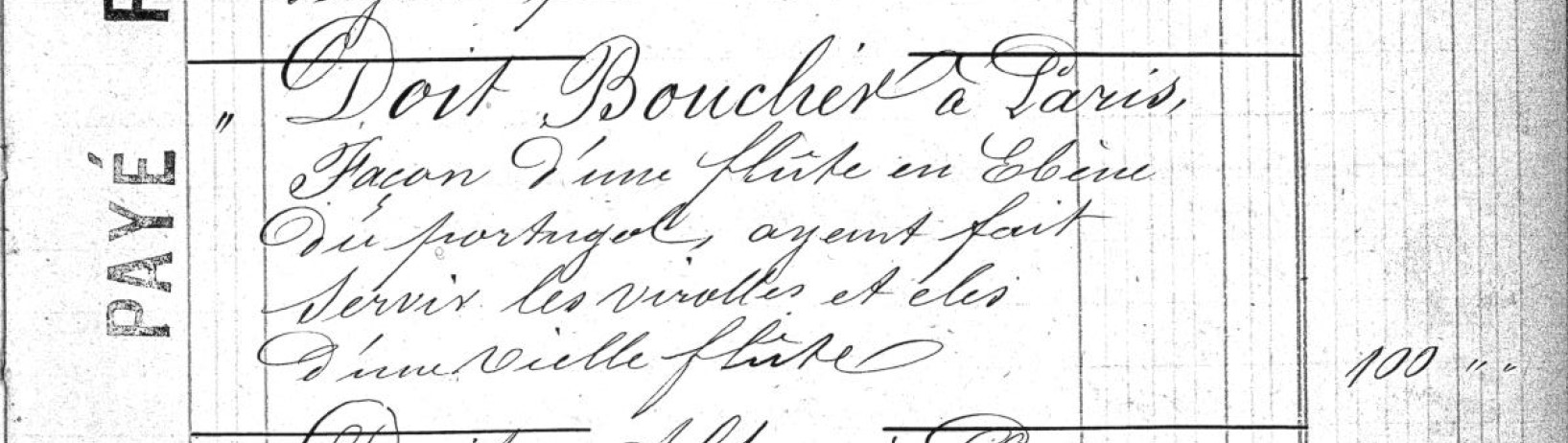
(Entry
dated March 15, 1858)
by David Chu, 2026, Maynard, Massachusetts
-
Continue to
Section 13, Piccolos
Copyright ©
2026 David Chu
For more information please email Alan Weiss at alan@vintagefluteshop.com