Vintage Flute Shop
Articles
“My Notes on the Accounting Records of Louis
Lot, 1855-1864”
13. PICCOLOS
If 1847 system cylindrical bore silver Boehm flutes were modern in 1855, the piccolo’s role in orchestral music had likewise evolved - from an occasional novelty or a doubling instrument to a recognizable voice in its own right.
Louis Lot made 87 Boehm system piccolos in total: 44 in C, 30 in Db, and 13 of unspecified pitch. These instruments were acquired by approximately 70 different individuals. More than half of these buyers also purchased silver, wood, or ring-key Louis Lot flutes. The piccolo was not simply a separate product line, but an important part of Louis Lot’s relationship with professional players.
Not all flutists acquired their Louis Lot instruments by purchasing a flute first and then adding a piccolo to complete the ensemble. Henri Altès bought his Boehm system C piccolo before ordering a Louis Lot silver flute the following year. His was the first C piccolo made by Louis Lot and the fourth piccolo overall. The three preceding instruments were all in Db.

(Entry
from October 20, 1855)
Both Db and C piccolos were used throughout the nineteenth century, with their relative popularity changing over time and according to musical context. Db piccolos became particularly associated with French military bands. C piccolos continued to be used in orchestral settings. Berlioz was keen on distinguishing the two in his symphonic music and Grand Traité d’instrumentation et d’orchestration modernes.
The following chart illustrates the growing production of C piccolos between 1855 and 1864, compared with Db piccolos.
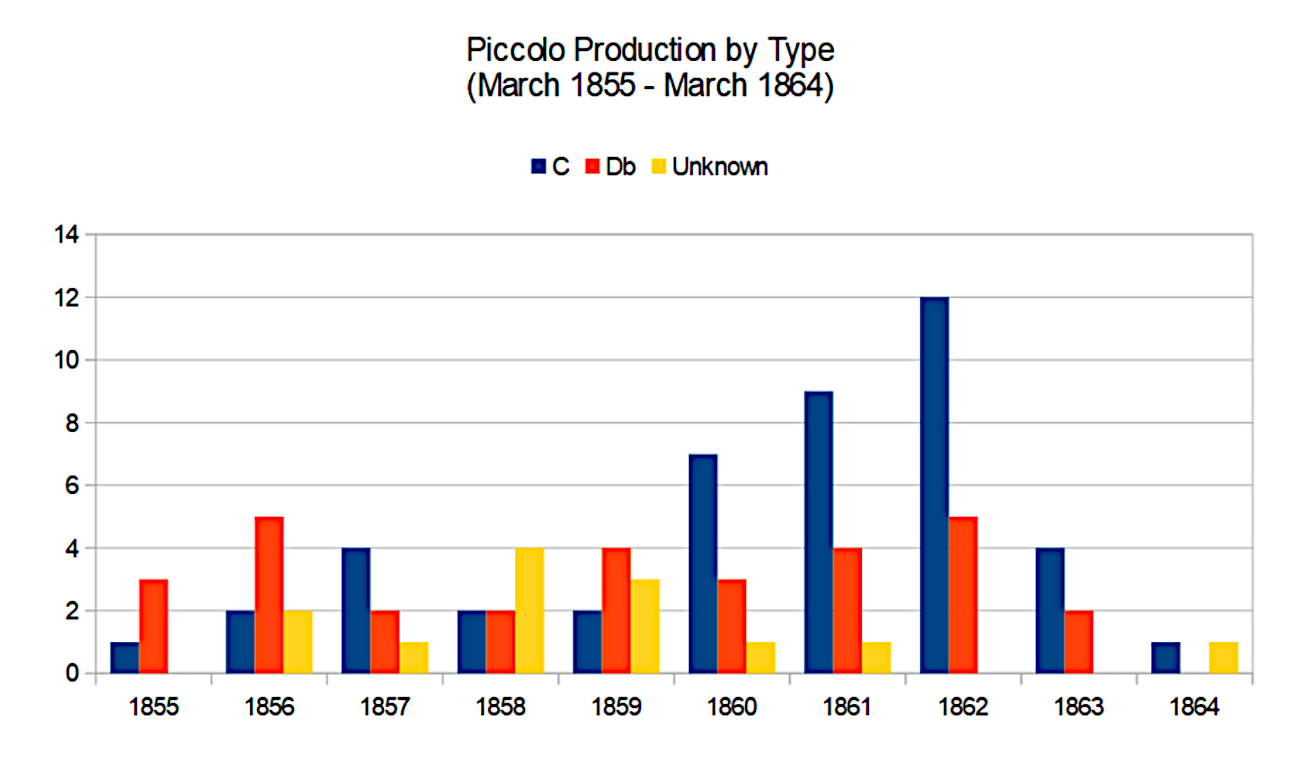
(Total production of C vs Db piccolos by year)
Most Louis Lot piccolos produced during this period did not include a Bb shake. Of the instruments recorded in the journal, only 19 were fitted with this option, indicating that it was a relatively uncommon feature in Lot’s piccolo production.
A metal lipplate was even more rare on Louis Lot piccolos. Only one example has been identified in the journal: a C piccolo with maillechort keys. The entry does not specify the material of the lipplate, so it is impossible to determine whether it was made of silver, maillechort, or another metal.
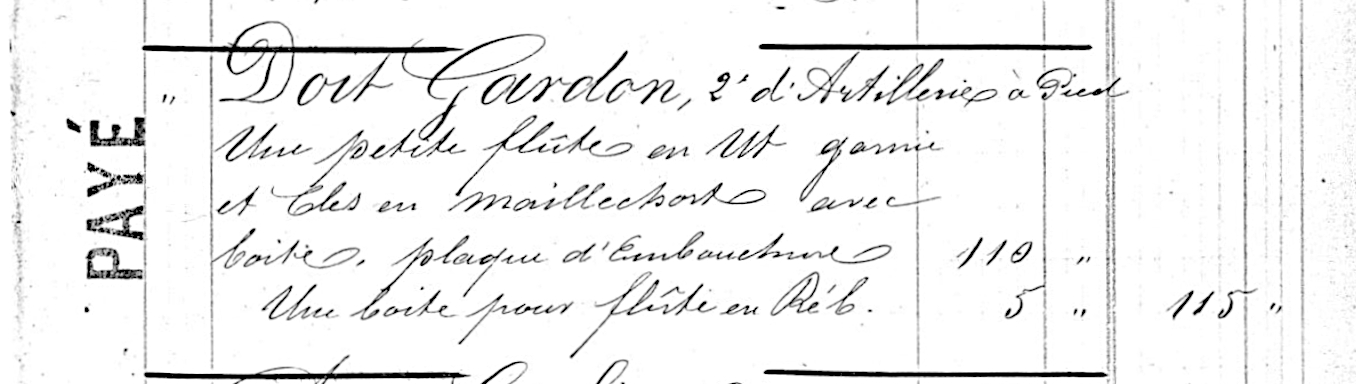
(Piccolo
with a metal lipplate)
Two C piccolos were ordered with an additional Db headjoint. It makes sense that a Db piccolo would not require a C headjoint, since pulling out the headjoint can lower its pitch. A C piccolo, however, cannot be raised in pitch once the headjoint is fully inserted. It is therefore reasonable to assume that piccolos fitted with two headjoints had bodies made with a native C scale. With an additional shorter Db headjoint, the player would have the option of playing at the higher pitch.
The only open G# piccolo in the journal was made for Richard Shepherd Rockstro. As was common with English players, he also specified several additional keys.
|
Date |
s/n |
Name |
Description |
|
5/28/1863 |
751 |
R.S. Rockstro |
Piccolo in C, open G#, C trill, D# on right-hand index, D# on middle finger. |
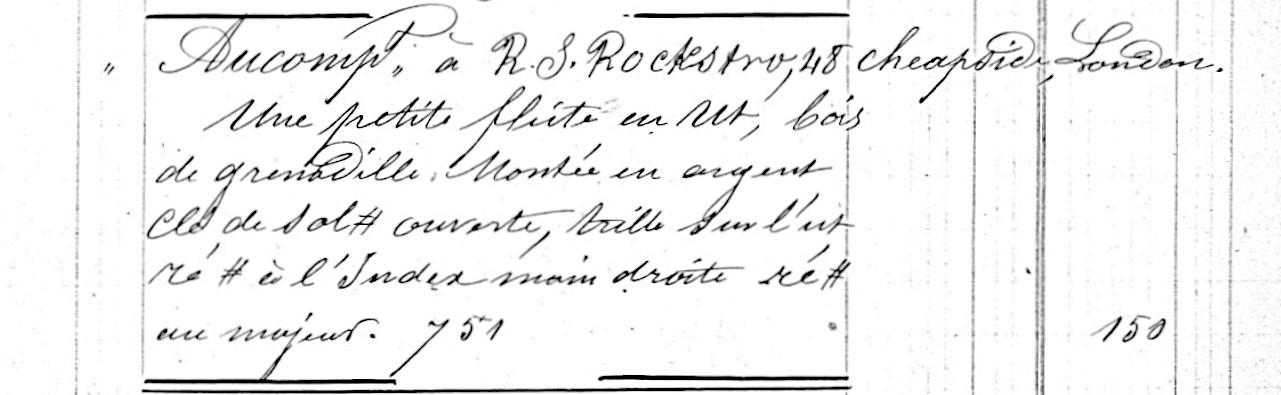
(Piccolo
No. 751)
To revisit the list of makers and innovators discussed in Section 10, several of those who purchased Louis Lot flutes also acquired piccolos, including Rockstro, Boehm, Buffet Crampon & Cie., Sax, and Millereau. The case of Millereau is particularly intriguing. His firm later produced a very good, large-bore, metal cylindrical piccolo extending down to low C. Given the unusual design, this may have been a one-of-a-kind experiment.
Just about half of the piccolos in the journal have serial numbers, but none of the piccolos made during the first two years do. Louis Lot’s record-keeping practices became more consistent in subsequent years, particularly in the registering of serial numbers.
Louis Lot’s wood piccolos complemented flutists who played silver flutes, cylindrical wood flutes, and ring-key conical wood flutes. Almost all the major flute players in the previous sections have bought a piccolo, and sometimes two or more.
Donjon, for example, purchased a piccolo in 1858, No. 260, and a second one the following year, No. 342.
Émile Astruc of Marseille owned both a C piccolo, No. 449, and a Db piccolo.
Simon Lauret, also based in Marseille, ordered five piccolos between 1856 and 1860.
Jean-François Nauwelaers, a ring-key flute player in Lyon who purchased 30 flutes from Louis Lot, also ordered two piccolos: one in 1860, No. 451, and the other in 1862, No. 648.
Charles Herval, flute professor of Le Havre, owned a C piccolo, No. 680.
Alexandre Dufau, based in Bordeaux, played a Db piccolo, No. 370.
Charles Derbaix, the dedicatee of Reichert’s Plaisanterie Musicale, bought No. 769. The flute community knows Reichert by his 7 Daily Exercices, Op. 5.
Jean-Baptiste Élie, a friend of Jean Firmin Brossa, acquired Nos. 276 and 569 in 1858 and 1861, respectively.
Joseph-Jean Fournez, whose name appeared in the journal at least 28 times, bought two piccolos: one in 1858, No. 330 and the other, without a serial number, in 1860.
Jean-Baptiste Laflorence might have used his piccolo with two headjoints in the Opéra-Comique and the Paris Opéra.
Victor-Henri Leplanquais, another member of the Opéra-Comique, kept two piccolos: a C and a Db, No. 299.
Two names are missing from Louis Lot’s piccolo roster: Dorus and Taffanel. They either had other piccolos or didn’t need them.
David Chu, 2026, Maynard, Massachusetts
-
Continue to
Section 14, Ordinary Flutes
Copyright
© 2026 David Chu
For more information please email Alan Weiss at alan@vintagefluteshop.com