Vintage Flute Shop
Articles
“My Notes on the Accounting Records of Louis
Lot, 1855-1864”
14. ORDINARY FLUTES
Louis Lot’s ordinary flutes constitute a whole domain of their own. Not so long ago, these instruments were the standard fare for flute players, then, almost suddenly, they became old-fashioned, particularly in France and in the world of Louis Lot.
In Louis Lot’s 1855 catalog, there were 18 individually priced items of ordinary flutes and piccolos ranging from 5 to 12 keys in silver and maillechort. However, not a single 12-key flute was recorded in the journal as being sold. In the 1870 catalog, the number of ordinary flute models was down to just 4 and piccolos were not offered although the prices remained the same. Over 250 ordinary flutes and piccolos of all kinds were produced up until 1864. They are now very rare in the marketplace.
The pie chart below displays the production figures of ordinary flutes by type: flutes, third flutes, third piccolos, C piccolos, Db piccolos, and 4 miscellaneous instruments.
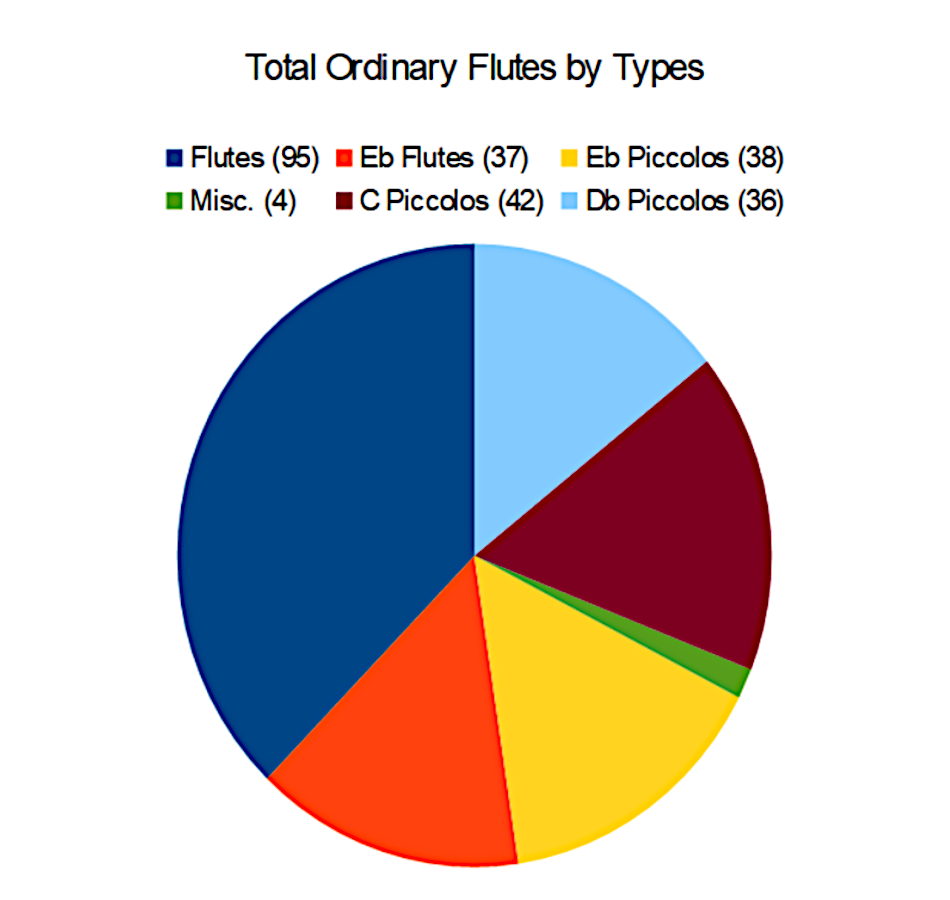
(Total
production of ordinary flutes by type)
The revenue generated from flutes far exceeded that of all the other types of instruments combined. Higher production numbers coupled with a higher price point naturally resulted in substantially greater revenue.
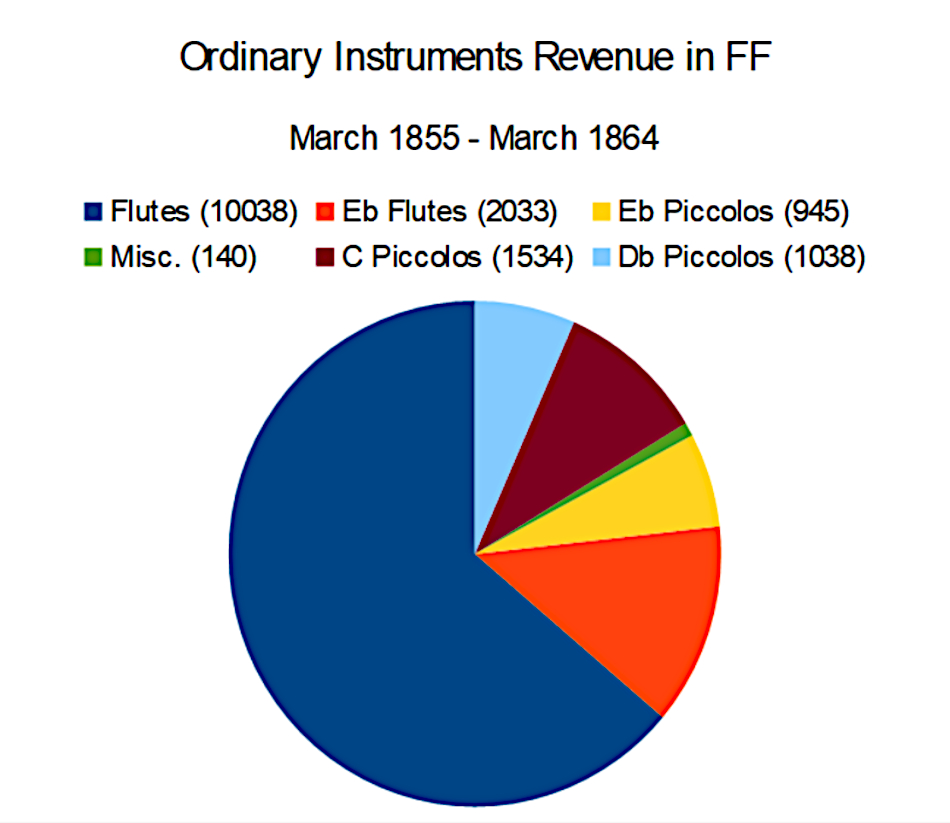
(Total
revenue of ordinary flutes by type)
Collectors highly prize the elegant 8-key Louis Lot flutes with silver keys due to their limited production run of just eight. Finding a 9-key flute with silver keys is an even more elusive prospect, as only two were made. Interestingly, out of all the 10-key (five produced) and 11-key (a single instrument) models in the journal, none were fitted with silver keys.
Serial numbers were rarely recorded in the journal, with only 30 numbers documented in total. The majority of these were for flutes, and only 4 for piccolos and one for an Eb flute, No. 601.
As noted elsewhere in this article, both Theobald Boehm and Adolphe Sax were customers of Louis Lot’s ordinary flutes. I was particularly excited, therefore, to find Verdi’s name in the ledger. In 1856, during a period when he spent a considerable amount of time in Paris, Verdi purchased an ordinary flute with 8 silver keys. According to music historian Bryan Aubrey, Verdi’s early musical education included the flute, bass clarinet, horn, and piano. He may have played the flute recreationally, studied it privately, experimented with the instrument, or acquired it for another musical purpose entirely.
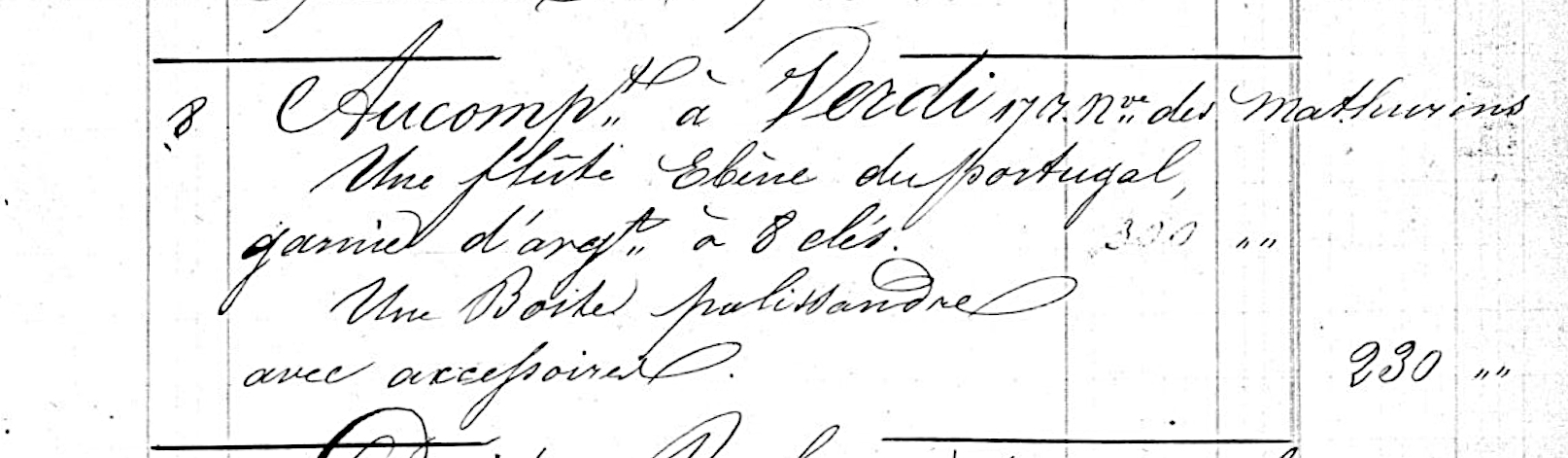
(Verdi’s
8-key flute)
Another opera composer and flutist, Auguste Mermet, purchased four 8-key flutes for himself and two of his students. The most valuable of these was No. 622, fitted with silver keys and priced at 210 FF. He also purchased a Moroccan leather case and accessories for an additional 20 FF. Mermet’s operas, Le Roi David (1846) and Roland à Roncevaux (1864), were both performed at the Paris Opéra.
|
Date |
s/n |
Name |
Description |
|
5/21/1860 |
458 |
Mermet |
8-key flute, maillechort keys |
|
1/22/1862 |
622 |
Mermet |
8-key flute, silver keys |
|
1/27/1862 |
- |
Mermet |
8-key flute, maillechort keys (for Collot) |
|
11/20/1863 |
- |
Cauvet |
8-key flute, maillechort keys (student of Mermet) |
Louise Farrenc, one of the most important women musicians of 19th-century France, was a composer, pianist, and professor at the Paris Conservatoire. Her husband, Aristide Farrenc, was a flutist, performing briefly at the Théâtre-Italien before turning his attention to his music shop, publishing activities, and teaching. His Louis Lot flute was a relatively modest six-key instrument with silver keys. He was also connected to Briccialdi, as the records show that he facilitated financial transactions on Briccialdi’s behalf.
|
Date |
s/n |
Name |
Description |
|
6/12/1862 |
- |
A. Farrenc |
6-key flute, silver keys |
Louis Lot’s production of ordinary flutes remained necessary, even if less profitable, because it kept him connected to the established French tradition of Jean-Louis Tulou and the older keyed-flute system. Simultaneously, he championed Theobald Boehm’s new flute design, marking a radical departure from the old guard.
At the outset, Louis Lot’s default customer for ordinary flutes was Henry Distin of London, who purchased 139 instruments for a total of 5,165 francs. Distin was a brass player, instrument maker, and music dealer who helped introduce Adolphe Sax’s instruments to Britain. His on-going orders may have been an important factor in encouraging Louis Lot to offer ordinary flutes in the first place. Distin placed his final order in 1860. By December 31, 1863, the records contain no further entries for ordinary flutes.
Most of Distin’s orders were for Eb flutes and piccolos, 72 in total, while only three Eb instruments were sold to other customers. Louis Lot’s Eb flute department might as well have been a subsidiary of Distin. This concentration of orders among a single customer may have been one of the many factors contributing to the decline of ordinary flute production, which dwindled to little more than a shadow of its former self in just 10 short years.
Distin’s purchasing pattern for C and Db piccolos was less concentrated. Of the 78 produced, 48 were purchased by Distin, while 15 went to Rudall, Rose, Carte & Co. and two were purchased by Adolphe Sax. The remaining instruments were sold to individual customers. One, in particular, was used by Louis-Marie-Gabriel Leplus who played in the orchestras of the Opéra-Comique, the Théâtre-Italien, and the Paris Opéra.
The four miscellaneous instruments mentioned in the beginning of this section were a 5-key low piccolo in A, a treble flute in G and two high piccolos in G. The latter three instruments were also sold to Distin. They all have maillechort keys. Given their rarity and highly specialized nature, these niche instruments would be highly collectible today.
by David Chu, 2026, Maynard, Massachusetts
-
Continue to
Section 15, French Terms
Copyright
© 2026 David Chu
For more information please email Alan Weiss at alan@vintagefluteshop.com