Vintage Flute Shop
Articles
“My Notes on the Accounting Records of Louis
Lot, 1855-1864”
2. CATALOG and PRICES
Louis Lot produced basically four categories of flutes:
Cylindrical
Boehm flutes in wood and metal (Cat. Nos. 1-8)
Conical
ring-key Boehm flutes (Cat. Nos. 9-13)
Boehm
piccolos (Cat. Nos. 14-15)
Ordinary
(simple-system) flutes and piccolos. (Cat. Nos. 16-33)
Download the Louis Lot Catalog here (English translation).
My main interest is in the first category, while the other three will provide a comparative backdrop for their manufacturing practices and other concerns.
In Louis Lot’s 1855 catalog, a silver Boehm flute (No. 5) is listed at 500 FF (French francs), and a similar wood flute in grenadilla (No. 1) is 450 FF. The list price of wood flutes remained the same for 50 years! Same goes for silver flutes after a one-time price increase in 1870 to 525 FF. Louis Lot’s long term steady prices were facilitated by the exceptionally stable French franc, although currency stability alone does not explain why Louis Lot maintained those nominal prices.
To compare:
A silver flute from the London firm Rudall, Rose and Carte (1852-1871) was listed at £26 5s. By using the simple conversion rate for the era of £1 to 25 FF, the RRC silver flute would be equivalent to 660 FF - quite a bit higher. It might be due to the higher cost of living in London than in Paris.
In 1877, Boehm and Mendler (1862-1888)sold their silver flutes with gold embouchures for 410 marks, equivalent to 506 FF. With the gold embouchure included, this price was considerably lower than what the French maker charged. Louis Lot, for example, added 80 to 100 FF for a gold embouchure, which was not offered as a standard catalog option until 1870. For the first two flutes fitted with gold embouchures, however, Lot charged only 60 FF. One of these flutes was #169, made in 1857 for Louis Dorus - perhaps a discount was offered.
However, the situation in the US was completely different. In the early days following Boehm’s 1847 invention, Badger was the only domestic flute maker producing Boehm system flutes. In 1868, he sold a flute with a low Bb to Henry Clay Wysham for US$250, which would have been about 1,250 FF. The American market for Boehm flutes was rather exclusive, where a single instrument could command a price far beyond that of its European counterparts.
The numbers and figures presented here are based on a straightforward reading of the records, with minimal extrapolation. Where a record does not specify whether an instrument has a C or D foot, for example, I use the price paid as a basis for determining which it most likely was.
The pricing information also helps clarify the meaning of certain terms used in the records. For English speakers, the distinction between clés argentées and clés en argent can be confusing:
clés
argentées = silver-plated keys
clés
en argent = keys made of solid silver
In the case of flute No. 718, the recorded price of 190 FF makes it clear that the keys could not have been solid silver. They were instead silver-plated. According to the record book, this was the first ring-key flute with silver-plated keys.
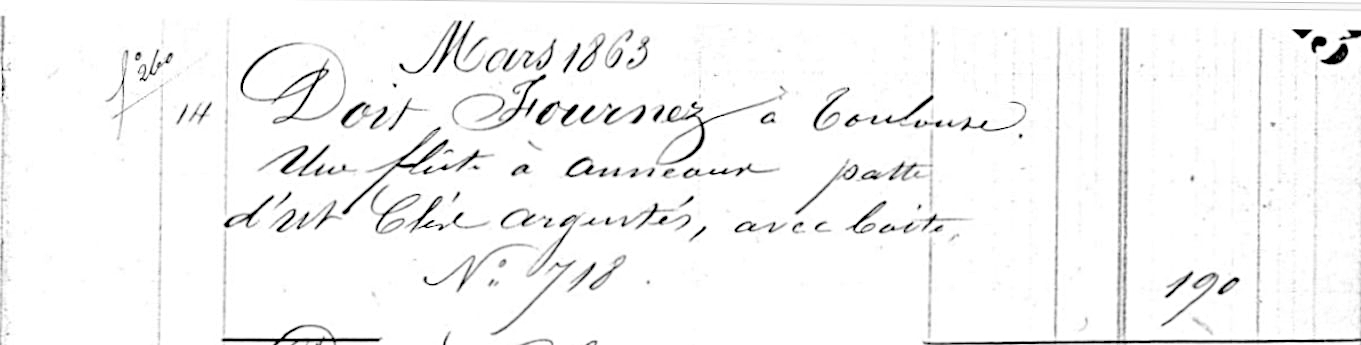
(No. 718, a silver-plated
ring-key flute)
DISCOUNTS
Louis Lot’s published catalogs and price lists functioned primarily as retail ceilings or baseline reference points rather than rigid fixed prices. The actual prices paid for instruments were often lower than their list prices. For example, during the first two years of production, many silver flutes were sold for 350 FF or 365 FF, representing a discount of nearly 30% from the catalog price of 500 FF. In these two years, only one recorded flute, #121, was sold at the full price to Pedro de Castillo in Havana, Cuba.
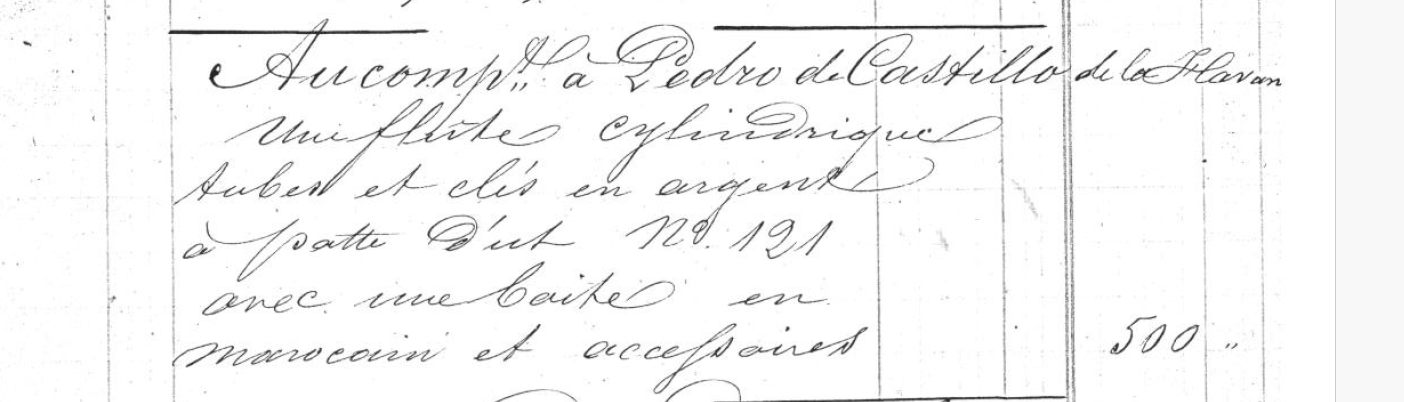
(No. 121 sold for full
price at 500 FF to Pedro de Castillo)
Cylindrical wood flutes sold during the same period were also discounted at approximately the same rate. It seems that discounts were given to almost every customer regardless of their status. Again, only one customer in the same two-year period, one Camberleche, is recorded as having paid the full price of 450 FF in cash for a wood flute.
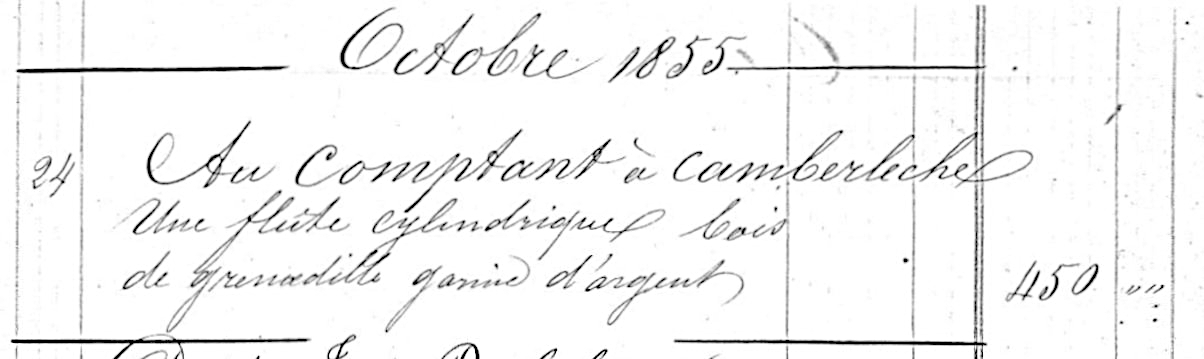
(A cylindrical wood flute
sold at full price to Camberleche)
No ring-key flutes with silver keys appear to have been sold at the full catalog price during the first two years. Later on, a few customers did pay the full price of 150 FF for the least expensive model - a D-foot flute with maillechort keys.
Ordinary flutes were discounted even more heavily, particularly those sold to the London dealer Henry Distin, who often received discounts of up to 45%. Distin purchased 139 of the 252 instruments made by Louis Lot — more than half of the company’s total production of ordinary flutes. Most of these were piccolos in various keys, along with many Eb flutes and 5- and 8-key C flutes, all fitted with maillechort keys except two.
Despite London’s higher cost of living, the London market appears to be more price-sensitive, generally favoring the less expensive maillechort keys rather than silver keys. Distin might have preferred cheaper instruments for a high profit margin or Louis Lot flutes were positioned differently in London.
Only two ordinary flutes with 8 silver keys were sold at full price in 1859 and 1861.
by David Chu, 2026, Maynard, Massachusetts
-
Continue to
Section 3, Serial Numbers
Copyright
© 2026 David Chu
For more information please email Alan Weiss at alan@vintagefluteshop.com